Quick Answer
Roof de-icing heat cables work by creating heated drainage paths along roof edges, gutters, and downspouts. When installed correctly, they help melt channels through snow and ice so water can drain instead of refreezing at the eaves.
The two common cable types are constant-wattage cables and self-regulating cables. Constant-wattage cables provide steady output while powered. Self-regulating cables adjust heat output based on local temperature conditions, making them a practical option for roofs, gutters, and downspouts with changing exposure.
Before choosing a roof de-icing cable, it helps to understand why ice dams form in the first place. If you have not read our earlier guide, start with how ice dams form and why roof drainage matters.
Once you understand the problem, the next question is simple: how do roof de-icing heat cables actually work, and which type should you choose?
This guide explains how roof heating cables operate, where they are installed, the difference between constant-wattage and self-regulating cable, and how to choose a setup that fits your home, roof layout, and winter conditions.
How Roof De-Icing Heat Cables Work
Roof de-icing heat cables are installed in targeted areas where snowmelt commonly refreezes. These areas often include the lower roof edge, gutters, downspouts, and sometimes roof valleys.
When the cable receives power, it produces heat along the cable path. This heat helps create channels through snow and ice so meltwater can move toward the gutter and downspout instead of backing up behind an ice ridge.
Important: roof de-icing cable can help reduce ice dam risk, but it cannot guarantee that ice dams will never form. Roof design, attic insulation, ventilation, gutter condition, snow load, and weather still matter.
Where Are Roof De-Icing Cables Installed?
The cable should be installed where it can support drainage. A common mistake is placing cable only on the roof edge while ignoring frozen gutters or downspouts.
Correct cable layout matters. Follow the product manual for spacing, routing, clips, gutter placement, downspout routing, and power connection requirements.
Manual Operation vs. Thermostat or Controller
Roof heating cables can be powered in different ways. Some systems are manually plugged in, while others are connected to a thermostat or roof heating controller.
| Control Method | How It Works | Best Fit |
| Manual Plug-In | The homeowner plugs in or turns on the cable when de-icing is needed. | Simple setups where the user can monitor weather and system operation. |
| Basic Thermostat | Turns power on or off based on temperature conditions. | Systems where temperature-based control is enough for the application. |
| Roof Heating Controller | Uses temperature and moisture sensing to help operate the cable during de-icing conditions. | Homes where automatic control and reduced unnecessary runtime are important. |
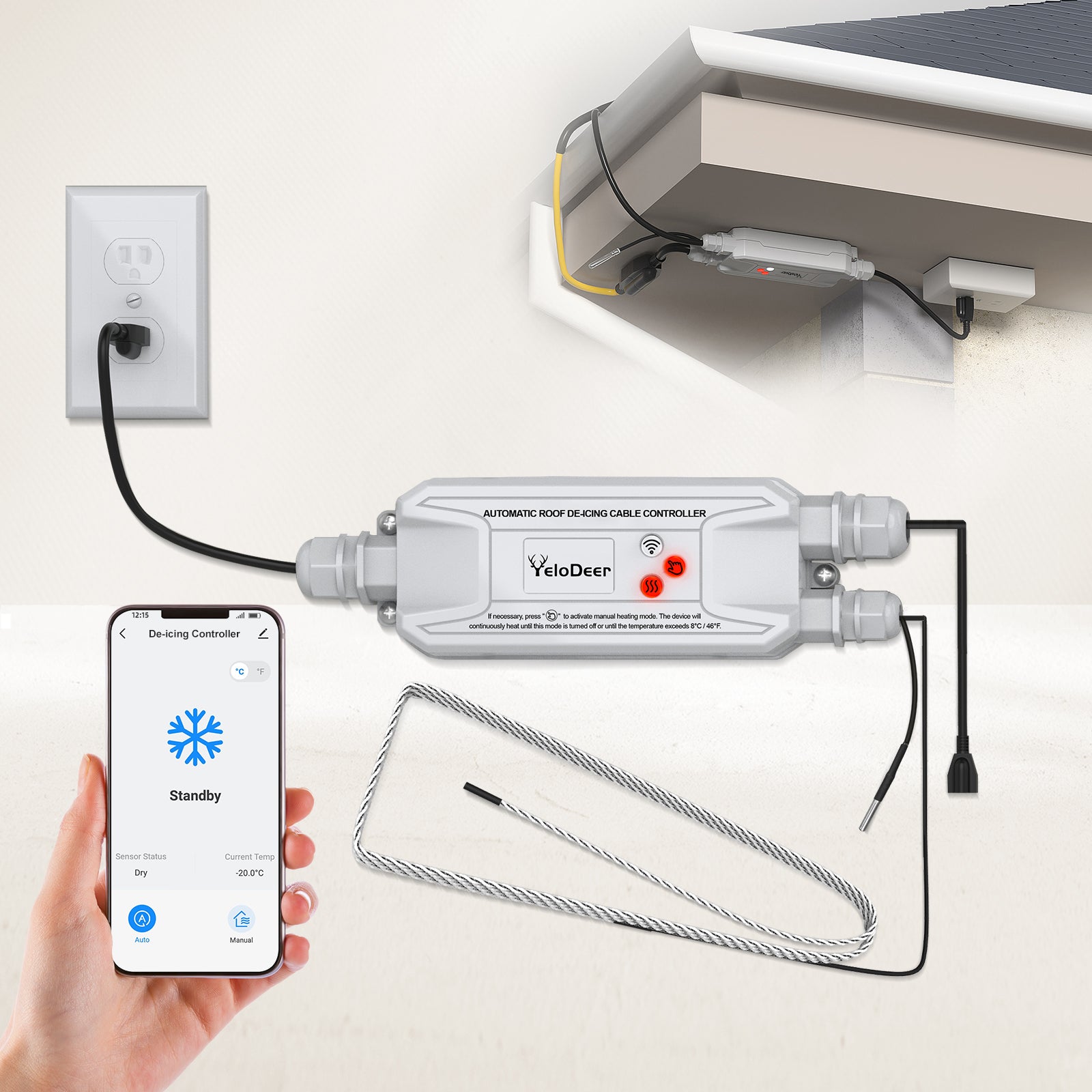
YeloDeer Roof Heating Control
The YeloDeer Roof Heating Control helps manage roof de-icing cable operation based on temperature and moisture conditions, reducing unnecessary runtime compared with always-on operation.
Explore Roof Heating ControlTypes of Roof Heating Cables
The two main types of roof heating cable are constant-wattage cable and self-regulating cable. Both can support roof de-icing applications, but they manage heat output differently.
1. Constant-Wattage Roof Heating Cable
Constant-wattage cable produces a fixed heat output while powered. This makes it straightforward to understand and can be useful for simpler layouts where steady output is desired.
Planning note: constant-wattage cable should be installed according to the product instructions and paired with proper electrical protection. Do not overlap, cut, or modify cable unless the product is specifically designed for that.
2. Self-Regulating Roof Heating Cable
Self-regulating cable adjusts heat output based on local temperature conditions along the cable. Colder sections produce more heat output, while warmer sections reduce output.
This can be especially useful on roofs because one section may be shaded and cold while another section is warmer from sunlight, attic heat, or changing weather.
YeloDeer Self-Regulating Roof De-Icing Cable
For roof edges, gutters, and downspouts with changing winter conditions, YeloDeer self-regulating roof de-icing cable helps adjust heat output based on local temperature conditions.
Shop Pre-Assembled Self-Regulating Heat Tape Shop Cut-to-Length Roof De-Icing CableImportant: self-regulating does not mean the cable fully turns itself off. It may still use power while energized. Use a compatible controller when automatic operation and energy management are needed.
Constant-Wattage vs. Self-Regulating Cable
Use this comparison to understand which cable type may be a better fit for your roof de-icing project.
| Feature | Constant-Wattage Cable | Self-Regulating Cable |
| Heat Output | Fixed output while powered. | Adjusts output based on local temperature conditions. |
| Energy Use | Depends heavily on runtime because output stays constant. | May reduce output in warmer areas, but still benefits from controller-based runtime management. |
| Roof Layout | Can work for simpler, more predictable layouts. | Often better suited for roofs with changing exposure, gutters, downspouts, or mixed sun and shade. |
| Upfront Cost | Often lower, depending on product and length. | Often higher, depending on product design, length, and accessories. |
| Installation Planning | Requires correct spacing, no unsafe overlap, and proper control. | Requires maximum circuit length review, startup current planning, correct termination where applicable, and proper control. |
| Best Customer Fit | Homeowners who want a basic de-icing setup for a simpler area. | Homeowners, contractors, and property managers who need a more adaptable roof, gutter, and downspout system. |
Which Roof De-Icing Cable Should You Choose?
The right cable depends on your roof layout, winter conditions, electricity cost, installation method, and whether you want automatic control.
Still unsure? Measure your roof edge, gutter length, downspout height, and problem ice areas before choosing a cable type. A photo of the roof edge and gutter layout can also help with product selection.
Don’t Forget Gutters, Downspouts, and Clips
A roof de-icing cable system works best when the drainage path is complete. If the roof edge is heated but the gutter or downspout remains frozen, meltwater may still have nowhere to go.
YeloDeer Roof De-Icing Accessories
Roof clips and controls help support a cleaner, safer, and more reliable roof de-icing installation when used according to product instructions.
Shop Roof Clips Explore Roof De-Icing ProductsCommon Mistakes to Avoid
FAQ
How do roof de-icing heat cables work?
They heat selected roof edge, gutter, and downspout areas to help create melt paths through snow and ice. This helps water drain instead of refreezing at the eaves.
Do roof de-icing cables prevent ice dams completely?
No. They can help reduce ice dam risk by supporting drainage paths, but attic insulation, ventilation, roof design, gutter condition, snow load, and weather also affect ice dam formation.
What is constant-wattage heating cable?
Constant-wattage cable produces a fixed heat output while powered. It can be useful for simpler layouts, but runtime control is important to reduce unnecessary energy use.
What is self-regulating heating cable?
Self-regulating cable adjusts heat output based on local temperature conditions. Colder areas produce more heat output, while warmer areas reduce output.
Is self-regulating cable more energy efficient?
It can reduce heat output in warmer areas compared with fixed-output cable, but actual energy use still depends on cable length, runtime, controller settings, weather, and installation layout.
Do I need a thermostat or controller?
A compatible roof heating controller is recommended for many systems because it can help operate the cable when temperature and moisture conditions call for de-icing, reducing unnecessary runtime.
Should cable be installed in gutters and downspouts?
Often, yes. If gutters or downspouts freeze, water may still be blocked even if the roof edge has cable. Follow the product layout instructions for your roof design.
Which cable is better for my home?
For simple layouts, constant-wattage cable may be enough. For changing roof conditions, shaded areas, gutters, downspouts, and custom layouts, self-regulating cable is often the more adaptable choice.
The Bottom Line
Roof de-icing heat cables help manage winter roof drainage by creating melt paths along roof edges, gutters, and downspouts. They are most effective when installed in the right pattern and paired with clean gutters, proper clips, outdoor electrical protection, and a suitable controller.
Constant-wattage cables provide steady heat output while powered and may fit simple applications. Self-regulating cables adjust output based on local temperature conditions and are often better for roofs with changing exposure or more complex drainage paths.
Before choosing a cable, measure the full roof edge, gutter, and downspout layout, identify where ice forms, and decide whether manual, thermostat, or controller-based operation is best for your winter setup.
Choose the Right Roof De-Icing Cable for Your Home
Need help comparing constant-wattage and self-regulating roof de-icing cable? Share your roof edge length, gutter length, downspout height, roof material, ice problem areas, photos, and local winter conditions. The YeloDeer team can help review a suitable setup.
Explore Roof De-Icing Products Shop Self-Regulating Heat Tape Shop Cut-to-Length Roof De-Icing Cable Shop Roof Heating Control