Enjoy free shipping on orders over $30.
We ship orders within 48 hours for quick delivery.
1. Our website accepts Visa, MasterCard, and American Express. If you are using a card issued by another bank, please ensure it is enabled for international transactions.
2. During payment, you may be required to complete 3D Secure (3DS) verification. Please ensure that the cardholder completes the verification to avoid payment failure.
3. If your usual spending amounts are relatively low and you are making a larger purchase, your bank may flag the transaction as a potential risk. If your payment fails, please contact your bank to approve the transaction.
Smart Roof & Gutter De-Icing Controller
Overview
Smart Roof & Gutter De-Icing Controller - 120V Plug-In / 208-240V Hardwired
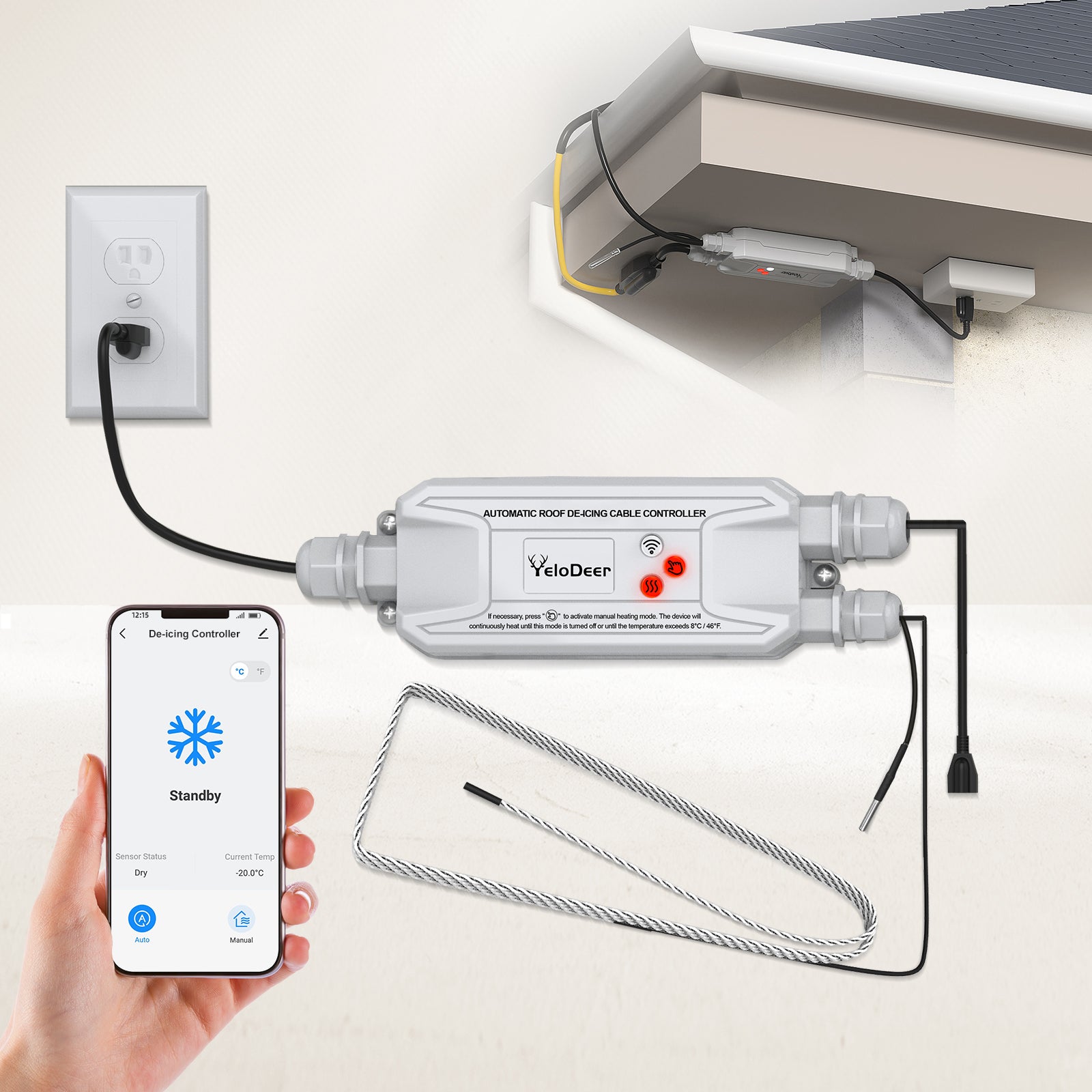
The YeloDeer Smart Roof & Gutter De-Icing Controller automatically manages compatible roof heating cables, gutter heat cables, and downspout de-icing cables based on actual winter conditions. Instead of simply running whenever the weather is cold, Auto Mode uses both temperature and moisture sensing to help heat only when ice-forming conditions are present.
Choose the 120V Plug-In Version for compatible 120V systems or the 208-240V Hardwired Version for compatible higher-voltage systems. Both versions use the same temperature and moisture logic, Manual Mode, Smart Life app control, WiFi monitoring, and power-outage memory.
Quick Use Snapshot
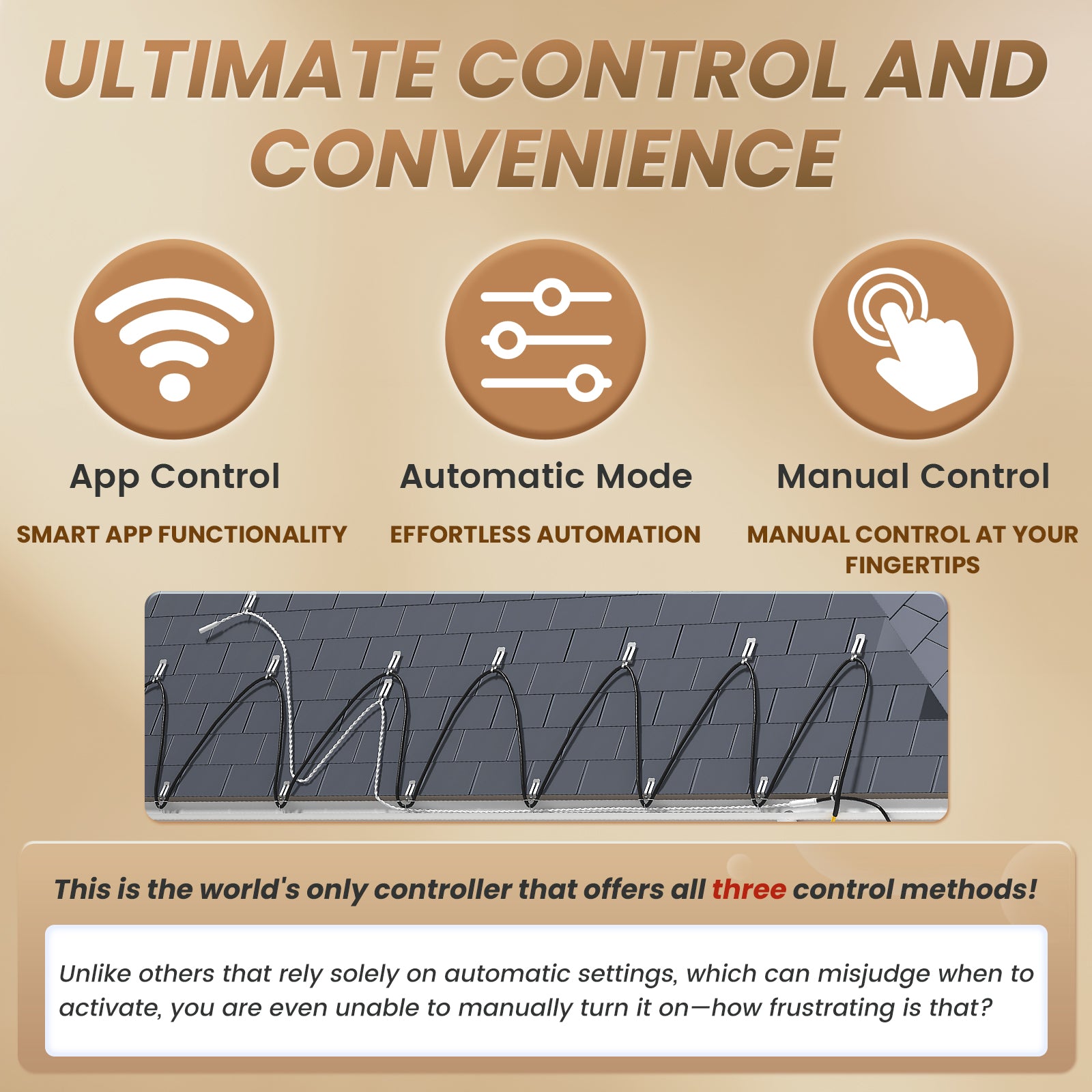
3 Ways to Stay in Control
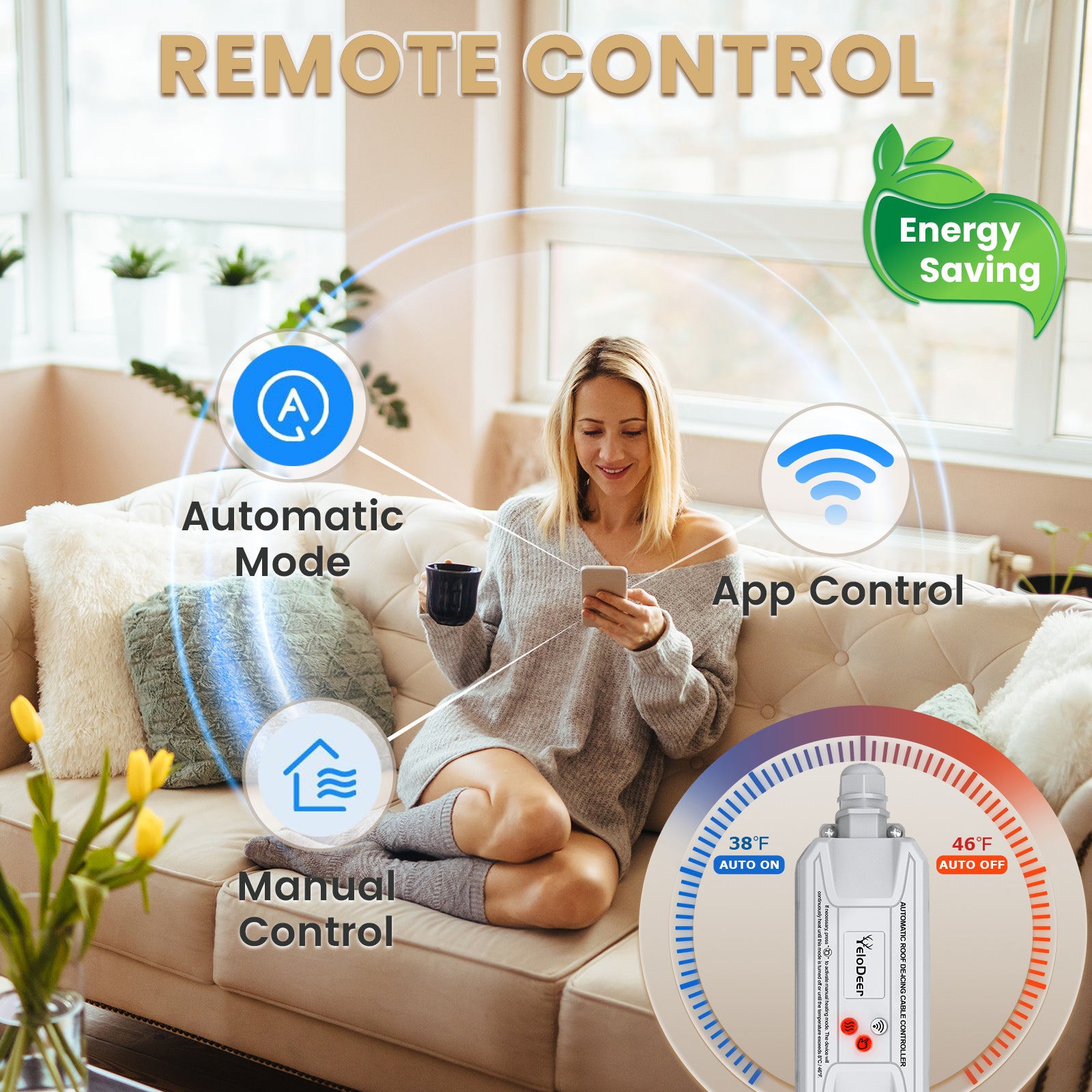
Why multiple control methods matter: Auto Mode handles normal operation without constant attention. Manual Mode gives you a direct override when you want heating immediately. App Control lets you see what the controller is detecting and adjust the system remotely. You are not dependent on only one method of control.
Key Benefits
Best For
Important Before You Order
This product is for roof, gutter, and downspout de-icing control.
It is not a pipe heat tape thermostat, electric floor heating thermostat, baseboard heater controller, or general-purpose heating controller.
How Auto Mode Works
Auto Mode does not turn on just because snow is visible on the roof.
Normal automatic heating starts when the temperature is approximately 38°F / 3°C or below and the moisture sensor detects liquid water from melting snow or ice.
This helps avoid unnecessary runtime during cold but dry conditions or when snow is present but no meltwater is reaching the sensor.
Why Moisture Sensor Placement Matters
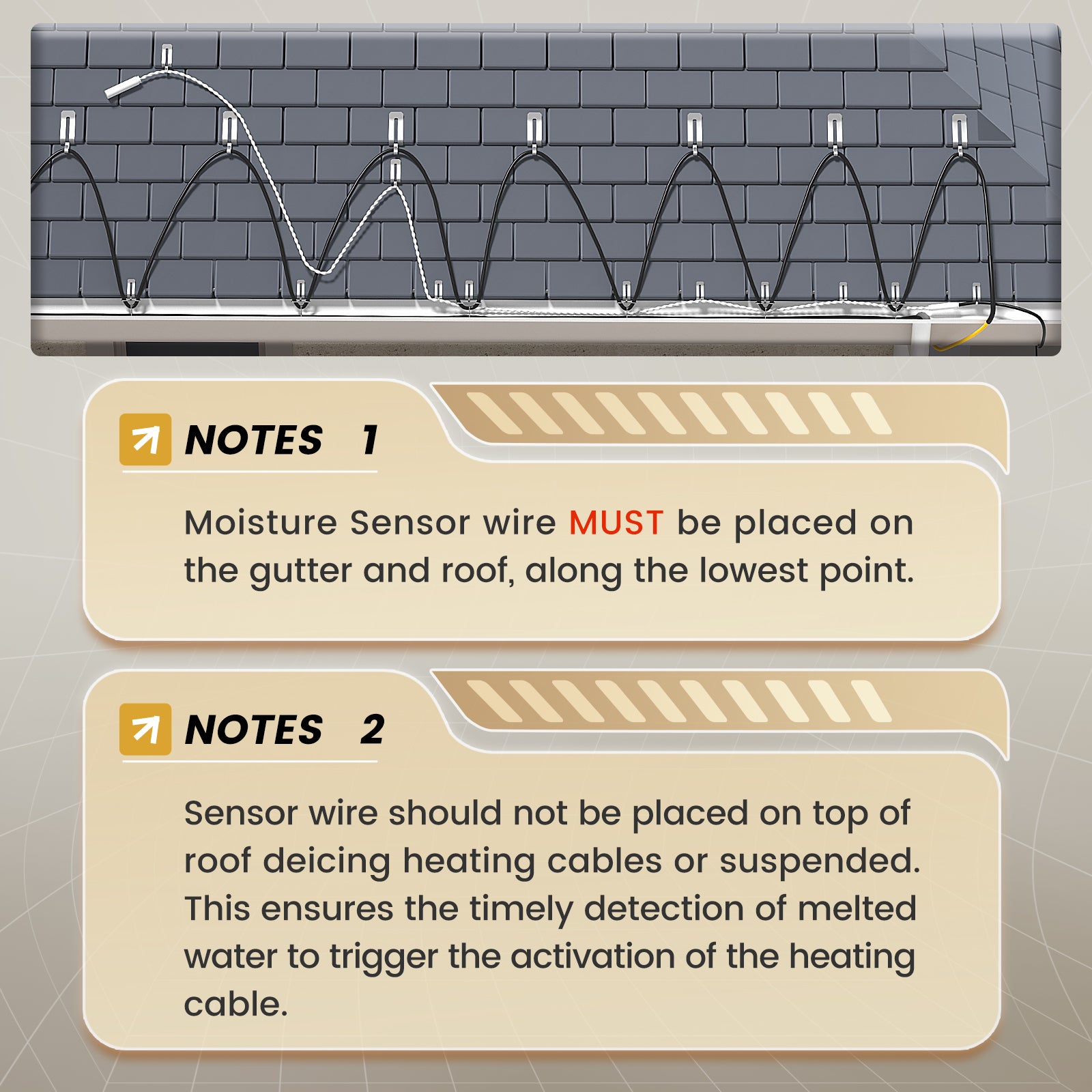
The moisture-sensing cable must be installed where meltwater is likely to contact it.
If the Smart Life app shows the sensor as Dry, Auto Mode may not activate even if snow is visible on the roof. Manual Mode can still be used for testing or temporary operation, but correct sensor placement is essential for reliable automatic control.

Applications
Recommended Applications
The YeloDeer Smart Roof & Gutter De-Icing Controller is designed for compatible electric heating cable systems used to maintain winter drainage paths and reduce refreezing problems on roofs.
Compatible with YeloDeer and Other Heating Cable Brands
The controller is not limited to YeloDeer heating cables. It can be used with compatible roof and gutter de-icing cables from other manufacturers when the electrical and installation requirements match.
When This Controller Is Most Useful
When Not to Use This Product
- Pipe heat tape control
- Electric floor heating
- Baseboard heater control
- In-pipe heating cables
- Loads that exceed the controller's 15A rating
- Roof layouts where the moisture sensor cannot contact meltwater
- Systems intended to rapidly melt heavy snow accumulation or a large existing ice dam
- Installations without appropriate outdoor electrical protection
For pipe freeze-protection control, choose YeloDeer Pipe Heat Tape Thermostat.
Specifications
Product Specifications
| Specification | 120V Plug-In Version | 208-240V Hardwired Version |
| Product Type | Smart roof & gutter de-icing controller | Smart roof & gutter de-icing controller |
| Rated Voltage | 110-120V AC | 208-240V AC |
| Maximum Current | 15A | 15A |
| Maximum Power | 1800W @ 120V | 3120W @ 208V / 3600W @ 240V |
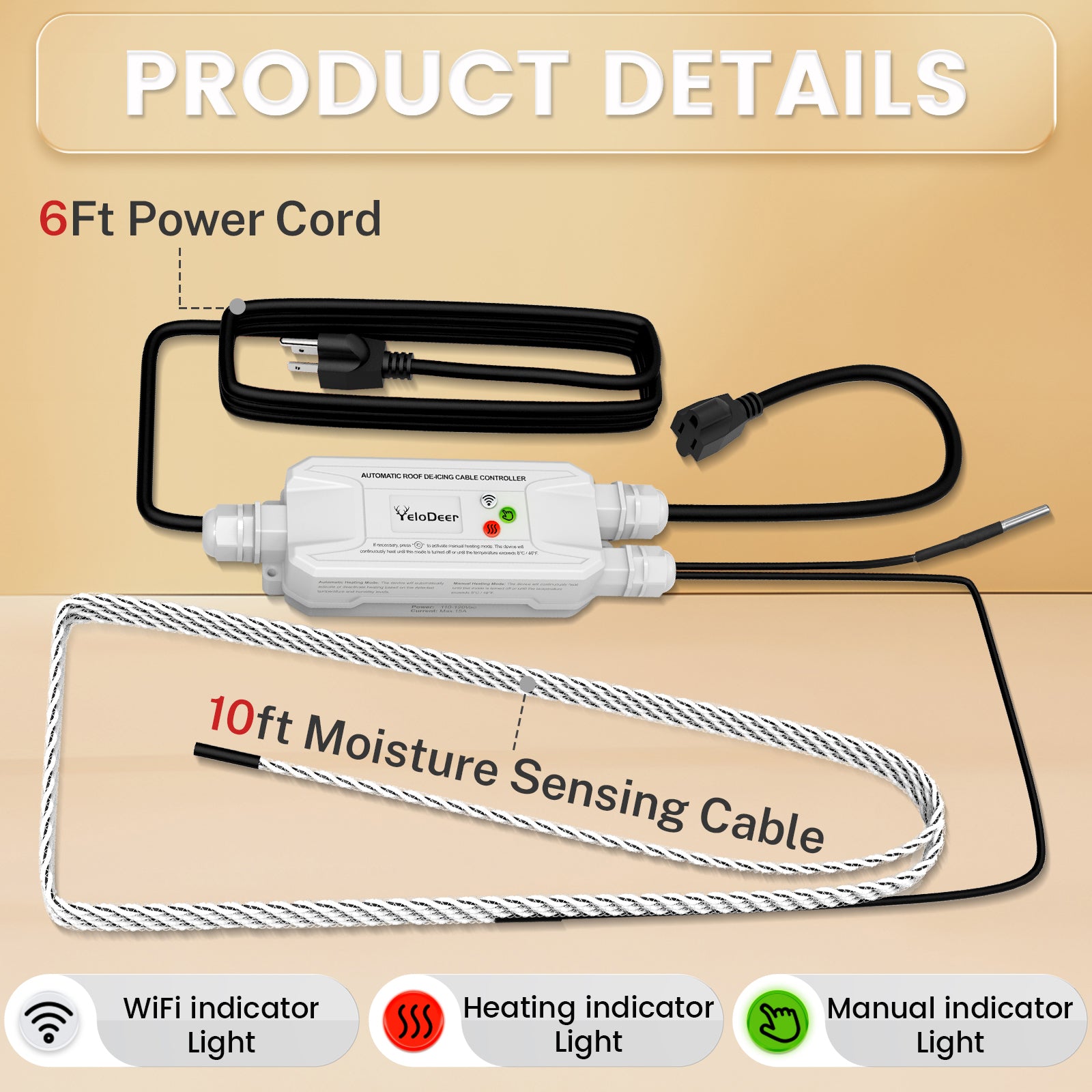
| Power Input | 6 ft / 1.8 m cord with grounded plug | 6 ft / 1.8 m hardwired power leads |
| Heating Cable Output | Plug-in receptacle | Hardwired load/output leads |
| Hardwired Lead Identification | Not applicable | Black: L1 / White: L2 / Green: Equipment Ground |
| Stripped Lead Length | Not applicable | Approx. 1/2 in. / 13 mm |
| Control Modes | Auto / Manual / App | Auto / Manual / App |
| Auto Activation | Approx. 38°F / 3°C or below + moisture detected | Same |
| Upper Temperature Limit | Approx. 46°F / 8°C | Same |
| WiFi | 2.4 GHz | 2.4 GHz |
| App | Smart Life | Smart Life |
| Moisture Sensor Wire | 10 ft / 3 m | 10 ft / 3 m |
| Controller Housing | IP65 | IP65 |
| Power Outage Memory | Supported | Supported |
| Included Accessories | 6 shingle clips, 2 spacers, 3 mounting screws | 6 shingle clips, 2 spacers, 3 mounting screws, 6 wire connectors |
Understanding the Three Control Methods
Moisture Sensor Function
Self-Regulating Heating Cable: How to Determine Maximum Cable Length
Do not determine maximum self-regulating cable length from nominal watts-per-foot or normal running current alone.
Self-regulating heating cable draws its highest current when it starts cold. The allowable circuit length therefore depends on the heating cable model, voltage, minimum start-up temperature, and circuit rating.
Use the heating cable manufacturer's Maximum Circuit Length or Maximum Heating Cable Length table. Because this controller is rated for a maximum of 15A, select a cable length that stays within the controller's 15A capability. If a manufacturer's table lists longer lengths for 20A, 30A, or 40A circuits, do not use those longer lengths when they would require more than this controller can handle.
Real YeloDeer KDL Example
YeloDeer's KDL Maximum Circuit Length table gives a practical example:
8W/ft self-regulating cable + 240V + -20°F / -29°C minimum start-up temperature + 15A circuit = 175 ft maximum circuit length.
This is why a simple calculation such as controller watts ÷ cable W/ft is not enough for self-regulating cable. Cold-start behavior matters.
How Much Electricity Can Automatic Control Save?
According to the U.S. Energy Information Administration, the average U.S. residential electricity price for January through May 2026 was approximately 18.11 cents per kWh.
At that rate, every 1,000W of heating cable costs about $0.181 per operating hour. If automatic control avoids just 8 hours of unnecessary runtime per day, the difference can become meaningful over a winter season.
| Connected Heating Load | Energy Avoided per Day if Runtime Drops by 8 Hours | Approx. Savings over 120 Days |
| 1,000W | 8 kWh/day | About $174 |
| 1,800W | 14.4 kWh/day | About $313 |
| 3,600W | 28.8 kWh/day | About $626 |
Example: If a homeowner would otherwise leave a 1,800W roof heating system energized 24 hours per day, but automatic control avoids 8 unnecessary operating hours per day, the calculated difference is about $313 over a 120-day winter at 18.11 cents/kWh.
This is an illustrative calculation, not a guaranteed savings claim. Actual savings depend on local electricity rates, heating cable load, snowfall, temperature, sensor placement, roof conditions, and actual heating runtime.
Source: U.S. Energy Information Administration - Electric Power Monthly.
Installation
Before Installation
Basic Installation Overview
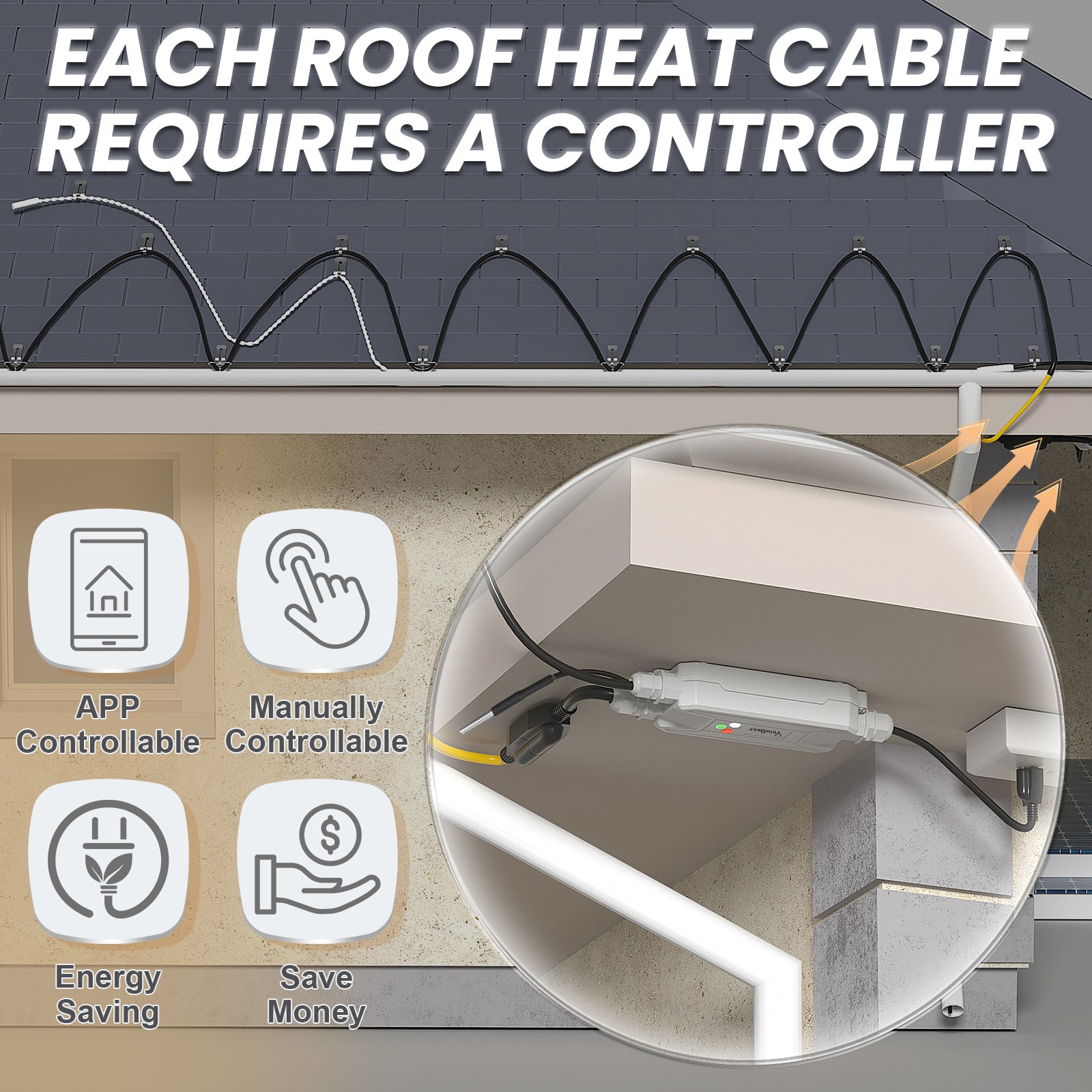
- Install the roof de-icing heating cable according to the heating cable manufacturer's instructions.
- Mount the controller under the soffit, eave, or another suitable location protected from direct weather exposure and standing water.
- Place the moisture-sensing cable where meltwater is likely to collect or flow.
- Confirm the controller version matches the heating cable and power supply voltage.
- Make the electrical connection using the instructions for the selected controller version.
- Restore power and connect the controller to the Smart Life app if remote control is desired.
- Test Manual Mode, heating output, temperature reading, and Dry/Wet sensor status before severe winter weather.
120V Plug-In Version
208-240V Hardwired Version
The 208-240V version is not a plug-in controller.
Power input and heating cable output connections must be hardwired using approved connections inside approved junction boxes. The 208-240V version should be installed by a qualified electrician.
Moisture Sensor Placement Guide
Do not cut, shorten, splice, or extend the moisture sensor wire.
Electrical Protection
The controller manages heating operation; it does not replace required overcurrent or ground-fault protection. Install the roof de-icing system in accordance with the heating cable manufacturer's instructions, applicable electrical codes, and local requirements. Where required, use appropriate equipment ground-fault protection. Do not assume that the controller itself provides required circuit protection.
Testing the System
Use Manual Mode to confirm that the controller can energize the connected heating cable.
If Manual Mode works but Auto Mode does not activate, the controller may not be defective. Check whether the Smart Life app shows the moisture sensor as Dry or Wet. A dry sensor is one of the most common reasons normal automatic heating does not begin.
Cold and Dry Periodic Heating
When outdoor temperature is below approximately 38°F / 3°C but the moisture sensor remains dry, the controller may run a short heating cycle of approximately 15 minutes every 3 hours. This is normal controller operation and can help create meltwater when snow is present but has not yet reached the moisture sensor.
FAQ
Product Basics
What is a roof de-icing controller?
A roof de-icing controller manages electric heating cables installed on roof edges, gutters, and downspouts. The YeloDeer controller combines ambient temperature sensing with a moisture-sensing cable to help determine when de-icing heat is needed.
Is this also called a roof heat tape controller or roof heat cable controller?
Yes. Customers may search for this type of device as a roof heat tape controller, roof heat cable controller, gutter heat cable controller, heat cable controller, roof controller, roof cable deicing control, or de-icing sensor/controller.
What is the difference between a de-icing sensor and a controller?
A sensor detects conditions. A controller uses those sensor inputs to switch the heating system. YeloDeer combines a built-in temperature sensor, an external moisture-sensing cable, switching control, Manual Override, and WiFi/App control in one roof de-icing control system.
Why does the controller use both temperature and moisture?
Low temperature alone does not mean roof heating is required. Temperature + moisture logic helps distinguish cold-and-dry weather from cold conditions where meltwater is present and may refreeze.
What are the three ways to control the system?
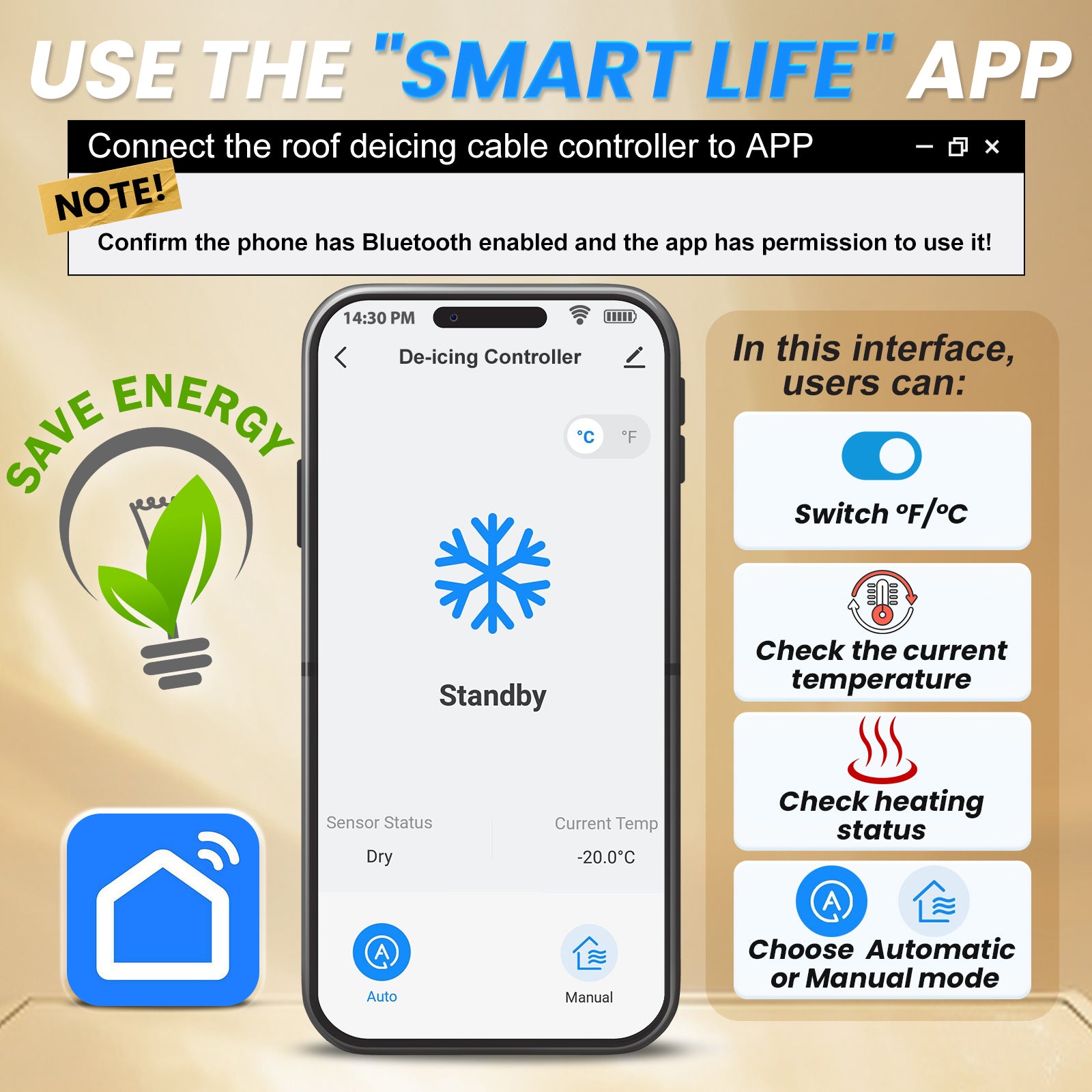
Auto Mode responds to temperature and moisture conditions. Manual Mode gives you a direct heating override for testing or temporary operation. Smart Life App Control lets you check status and switch operating modes remotely when connected to WiFi.
Auto Mode & Sensor Questions
Why does Auto Mode not turn on when there is snow on the roof?
Snow alone does not trigger normal Auto Mode. The temperature must be within the operating range and the moisture sensor must detect liquid water. If the Smart Life app shows the sensor as Dry, meltwater may not yet be reaching the sensor.
Is the controller defective if Manual Mode works but Auto Mode does not?
Not necessarily. If Manual Mode powers the heating cable, the controller output is operating. A common reason Auto Mode does not activate is that the moisture sensor remains dry or is not positioned in the meltwater path.
Where should I install the moisture sensor?
Install it where melted snow or ice naturally produces water, such as the bottom of a gutter near the heating cable or a roof-edge meltwater path. Correct placement is essential because a sensor that remains dry cannot tell the controller that meltwater is present.
Can I cut or extend the moisture sensor cable?
No. Do not cut, shorten, splice, or extend the moisture sensor wire.
Why does the controller sometimes heat when the sensor is dry?
When temperature is below approximately 38°F / 3°C and the sensor remains dry, the controller may run a short heating cycle of approximately 15 minutes every 3 hours. This is normal operation.
Compatibility & Cable Length
Can I use this controller with another brand of roof heating cable?
Yes. The heating cable does not need to be YeloDeer brand. Verify voltage, electrical load, roof/gutter application, connection method, and Maximum Circuit Length before installation.
Can I use it with self-regulating heating cable?
Yes, when the cable is suitable for roof and gutter de-icing and its electrical requirements match the controller. Self-regulating heating cable must also stay within the manufacturer's Maximum Circuit Length because cold-start current is higher than normal running current.
How do I determine the maximum length of self-regulating heating cable?
Use the heating cable manufacturer's Maximum Circuit Length table. Find the cable model, voltage, lowest expected start-up temperature, and a circuit length that stays within this controller's 15A capability. Do not determine maximum cable length from nominal watts-per-foot or steady-state current alone.
For a real example, see the YeloDeer Maximum Circuit Length Guide.
My cable says 5W/ft. Can I divide 1800W by 5W/ft to get the maximum length?
No. That calculation does not account for the higher cold-start current of self-regulating heating cable. Use the cable manufacturer's Maximum Circuit Length table.
The cable table lists 15A, 20A, 30A, and 40A lengths. Which should I use?
This controller has a maximum current rating of 15A. Do not select a longer cable length that depends on more current than the controller can handle. Actual branch-circuit protection must also follow the heating cable manufacturer's instructions and applicable electrical codes.
How much roof heating cable can one controller handle?
There is no single footage answer. Maximum length depends on cable type, voltage, watts per foot, cold-start characteristics, minimum start-up temperature, and the manufacturer's Maximum Circuit Length. The connected system must remain within the controller's 15A maximum rating.
120V vs. 208-240V
Can I use the controller with 208V roof heating cable?
Yes. Choose the 208-240V Hardwired Version and verify that the heating cable is rated for the actual supply voltage.
Can I use it with a 240V roof heat cable?
Yes. Choose the 208-240V Hardwired Version. Do not use the 120V Plug-In Version with a 240V heating system.
Can I plug in the 208-240V version?
No. The 208-240V version is designed for hardwired installation.
Should an electrician install the 208-240V version?
Yes. A qualified electrician should install the hardwired version and confirm that wiring, grounding, junction boxes, overcurrent protection, and required ground-fault protection meet the installation requirements.
Energy Use & Remote Control
How much electricity does roof heat cable use?
Electricity use depends on the heating cable's actual power draw and operating time. At an electricity price of 18.11 cents/kWh, a 1,000W heating system costs about 18.1 cents for each hour of operation.
Can an automatic roof de-icing controller reduce my winter electricity bill?
It can reduce unnecessary runtime compared with leaving roof heating cable continuously energized. Using the U.S. residential average electricity price of 18.11 cents/kWh for January-May 2026, avoiding 8 hours of unnecessary daily operation on a 1,800W system calculates to about $313 over 120 days.
This is an illustrative calculation, not a guaranteed savings claim. Actual savings depend on local electricity rates, cable load, weather, sensor placement, roof conditions, and actual runtime.
Can I control the roof heater when I am away from home?
Yes. When connected to WiFi, the Smart Life app allows remote status checking and switching between Auto and Manual operation.
Does the controller work with 5 GHz WiFi?
The controller requires a 2.4 GHz WiFi network for connection.
What happens after a power outage?
The controller supports power-outage memory and restores its previous operating settings after power returns.
Roof & Installation Questions
Can I use the controller on a metal roof?
Yes, when used with heating cable suitable for metal-roof de-icing. Protect the heating cable and moisture sensor from damage caused by sliding snow or ice.
Can it control gutter and downspout heating cable?
Yes. Gutter and downspout de-icing are primary applications for this controller.
Can this controller remove a large ice dam that already formed?
The system is mainly designed to help prevent ice dams and maintain drainage paths. It is not intended to rapidly remove a large existing ice dam or heavy snow accumulation.
Is the controller waterproof?
The controller housing is rated IP65, but electrical connections, plugs, wire connectors, and junction boxes must still be protected appropriately and should never sit in standing water.
Does this controller replace a breaker, GFCI, or GFPE device?
No. The controller manages heating operation. It does not replace overcurrent or ground-fault protection required by the heating cable manufacturer or applicable electrical codes.
Can I use this as a pipe heat tape thermostat?
No. This controller is specifically intended for roof, gutter, and downspout de-icing applications. For pipe freeze protection, use a dedicated Pipe Heat Tape Thermostat.
Troubleshooting & Selection Help
What should I send YeloDeer if I am not sure whether my heating cable is compatible?
Please send:
- Heating cable brand and model number
- 120V / 208V / 240V rating
- Watts per foot
- Planned heating cable length
- Lowest expected winter/start-up temperature
- Manufacturer's Maximum Circuit Length table
- Roof and gutter layout photos, if available
Email yelodeer@yelodeer.com and our team can help review basic controller compatibility before installation.
What should I send if Auto Mode is not working as expected?
Please email yelodeer@yelodeer.com with:
- Roof heating cable layout photos
- Moisture sensor placement photos
- Smart Life app screenshot showing Dry/Wet status
- Outdoor temperature
- Whether Manual Mode works
- Heating cable model and installed length
- Roof type and gutter/downspout layout
- Where ice normally forms
Guides
Use these YeloDeer resources to plan cable length, understand controller operation, troubleshoot roof de-icing problems, and choose compatible heating components.
Learn why self-regulating heating cable length depends on voltage, W/ft, start-up temperature, and circuit rating.
Review Auto Mode, Manual Mode, periodic heating, WiFi operation, and common troubleshooting steps.
Learn about roof cable selection, installation planning, winter safety, and system maintenance.
Understand heating cable power use, winter operating cost, and why automatic control can reduce unnecessary runtime.
Answers to common questions about ice dams, roof heating cable, gutters, downspouts, and winter drainage.
Explore 120V/240V cut-to-length self-regulating heat trace for roof, gutter, and pipe applications.
Related Products & Support
- Browse YeloDeer Roof & Gutter De-Icing Cables.
- For pipe freeze-protection control, choose YeloDeer Pipe Heat Tape Thermostat.
- For product selection or troubleshooting, contact yelodeer@yelodeer.com with cable specifications and installation photos.