Quick Answer
Winter roof problems can be confusing because the visible symptom is not always the real cause. Icicles, frozen gutters, hidden valley ice, and ceiling stains can all point to different parts of the same drainage problem.
This FAQ explains what ice dams are, where they usually form, how roof de-icing cables help, and when other improvements such as air sealing, insulation, ventilation, snow removal, or professional inspection may also be needed.
Winter roof problems can be confusing because the visible symptom is not always the real cause. A few icicles may look harmless. A small ice ridge near a valley may cause more damage than a large icicle at the front eave. A roof may even leak when no obvious ice dam can be seen from the ground.
This guide answers common homeowner questions about ice dams, icicles, roof leaks, roof rakes, and roof de-icing cables.
Ice Dam FAQ for Homeowners
Do icicles mean I have an ice dam?
Not always. Icicles usually mean that snow is melting somewhere on the roof, running downward, and refreezing at a colder edge. That is a warning sign, but it is not a complete diagnosis.
Small icicles can form during normal freeze-thaw weather. Larger, repeated, or growing icicles near gutters, soffits, fascia boards, windows, or roof valleys may point to a more serious drainage or heat-loss problem.
Practical rule: icicles tell you to inspect the roof more carefully. They do not, by themselves, tell you how severe the problem is.
Are gutters the cause of ice dams?
Usually, no. Gutters are often where ice becomes visible, but they are not usually the root cause of an ice dam.
Ice dams form when part of the roof is warm enough to melt snow while a lower part of the roof remains below freezing. The melted water runs downward and refreezes near the colder roof edge, gutter line, valley, or overhang.
Where do ice dams usually form?
The most common place is the roof edge, especially over heated living space. But ice dams can also form in less obvious locations.
The most important thing is not just where ice is visible. It is where water can get trapped. A thin ice ridge in the wrong location can be more damaging than large icicles in a less vulnerable area.
Can a roof leak without a visible ice dam?
Yes. A roof can leak even when there is no obvious ice dam visible from the ground.
Ice can be hidden under snow, behind gutters, inside a valley, above a skylight, or near a roof penetration. Water can also travel inside the roof assembly before showing up indoors.
What to check: if the leak happens mainly after snow and freezing weather, inspect for hidden ice near valleys, skylights, dormers, chimneys, and eaves. If the same area leaks during rain, the issue may be flashing, roof penetrations, or another waterproofing detail rather than an ice dam.
Can roof de-icing cables completely solve ice dams?
Roof de-icing cables can help manage ice and meltwater in specific areas, but they should not be presented as a complete cure for every ice dam problem.
Their main job is to create or maintain drainage paths through snow and ice. This can be very useful at eaves, gutters, downspouts, valleys, and recurring trouble spots.
Best use case: use roof de-icing cables as a preventive drainage solution for known problem areas, not as the only answer to a serious building envelope problem.
Should roof de-icing cables be installed before or after ice has already formed?
Roof de-icing cables work best when installed before winter weather arrives.
They are designed to help prevent ice buildup and maintain meltwater channels. They are not the best tool for removing a large ice dam that has already formed.
Safety note: once a heavy ice dam exists, the safer option is often professional removal, especially on steep roofs, high eaves, or areas with heavy ice.
Practical takeaway: plan installation in fall or before the first major winter storm, especially if the same roof edge, valley, or downspout freezes every year.
Roof rake or heating cable: which is better?
They solve different parts of the problem.
A roof rake removes snow from the roof. Less snow means less meltwater and less fuel for ice dams. It can be a low-cost short-term solution if the roof edge is easy to reach safely from the ground.
A heating cable does not remove snow from the whole roof. Instead, it helps maintain drainage channels at selected areas such as eaves, gutters, valleys, and downspouts.
| Roof Rake | Best for low, simple, safely reachable roof edges after snowfall. |
| Roof De-Icing Cable | Best for recurring ice areas, frozen gutters, downspouts, valleys, and locations that are difficult to clear manually. |
For many homes, the best answer is not one or the other. A roof rake may help after heavy snow. A de-icing cable may help protect the areas that repeatedly freeze or are difficult to clear.
Do insulation and attic ventilation still matter if I install heat cable?
Yes. Insulation and attic ventilation still matter.
Ice dams often begin when warm indoor air or heat from the living space warms the roof deck from below. Better air sealing helps stop warm air from escaping into the attic. Better insulation reduces heat transfer. Proper ventilation helps keep the roof deck closer to outdoor temperature.
Roof de-icing cable works at the roof surface. It helps manage meltwater. It does not stop the roof from being warmed from underneath.
Best long-term approach: use air sealing, insulation, and ventilation to reduce the cause of uneven roof temperatures. Use de-icing cable to help protect the most vulnerable drainage paths.
Where should roof de-icing cables be installed first?
Start with the areas where meltwater must leave the roof safely. The goal is not to cover the entire roof with cable. The goal is to create a continuous path for water to move from the roof surface into the gutter and down through the downspout.
Can heat cable damage shingles?
A properly selected and correctly installed roof de-icing cable should be installed according to the product instructions and supported with suitable roof clips or approved mounting methods.
Problems are more likely when cable is loosely placed, improperly attached, overlapped in ways not allowed by the product design, installed on incompatible roofing materials, or used with the wrong controller or power source.
Installation reminder: the cable itself is only one part of the system. Correct layout, fastening, electrical protection, and seasonal inspection all matter.
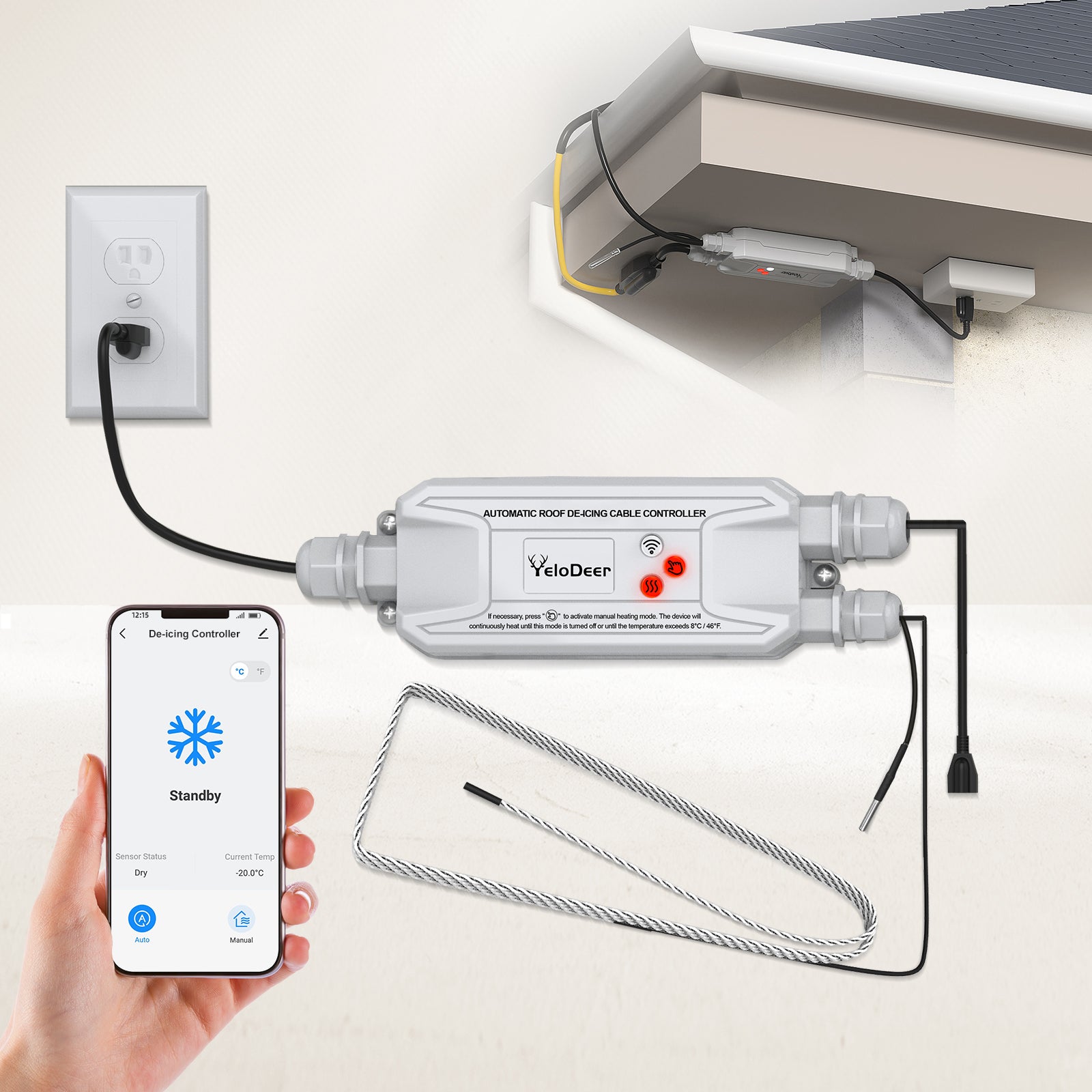
Do I need a controller for roof de-icing cable?
A controller is strongly recommended for many installations.
Without a controller, users often turn the cable on too late, leave it on too long, or forget to operate it when weather conditions change. A controller can help the system run when snow, temperature, or moisture conditions make ice buildup more likely.
Controller Recommendation
For better energy use and more consistent winter protection, a temperature or moisture-based controller is usually a better choice than relying only on manual operation.
Explore YeloDeer ControllersHow do I know how much roof de-icing cable I need?
The required length depends on the roof edge, eave depth, gutter length, downspout length, valley length, and the layout pattern recommended for your roof type.
A common mistake is measuring only the straight gutter length. That usually underestimates the cable needed because the cable may need to run in a zigzag pattern along the roof edge, through gutters, and down into downspouts.
Is roof de-icing cable only for gutters?
No. Gutters are only one part of the system.
Roof de-icing cable may be used along eaves, roof edges, gutters, downspouts, valleys, and other areas where ice blocks water drainage. In many cases, the roof edge and gutter should be treated together so that meltwater has a complete path out of the problem area.
Practical takeaway: think in terms of a full drainage path, not a single heated spot. From the roof, into the gutter, down the downspout, and away from the home.
Recommended YeloDeer Solution
For recurring ice dams, frozen gutters, blocked downspouts, roof valleys, and other drainage trouble spots, YeloDeer roof de-icing cables can help maintain a path for meltwater to move safely through snow and ice.
The best layout depends on your roof edge, gutter length, downspout path, valley areas, power source, and the locations where ice forms repeatedly.
Explore YeloDeer Roof De-Icing CablesThe Bottom Line
Ice dams are not always obvious. Icicles, hidden valley ice, frozen gutters, winter roof leaks, and ceiling stains can all point to different drainage and heat-loss problems.
Roof de-icing cable can help protect recurring trouble spots by maintaining drainage paths through snow and ice. But the best long-term strategy often combines cable layout, snow removal when safe, gutter maintenance, attic air sealing, insulation, ventilation, and professional inspection when needed.
Start by identifying where water is melting, where it is refreezing, and where it needs to drain. Once you understand the path of the water, choosing the right solution becomes much easier.
Need Help Choosing a Roof De-Icing Layout?
Send us photos of your roof edge, gutters, downspouts, valleys, and the areas where ice forms repeatedly. The YeloDeer team can help you review the drainage path and choose a suitable roof de-icing cable setup.
Contact YeloDeer