IPHC-T (In Pipe Heat Cable - T Fitting) 3W/FT Extra 4ft Power Cord High-Pressure Rated (230 PSI Max) GFCI CSA Certified for Drinking Water Corrosion Resistan Custom Length Available
Regular price $70.00 USD Sale price $70.00 USD Regular price $94.99 USD
Sale 26.31% $24.99 USD (26.31%)

Standard products are 120V. For custom orders, please select the "Custom" option. After your purchase, our engineering team will contact you via email within 1 business day to confirm your specific requirements (Voltage: 120V/240V, Length, etc.).

📩 Please ensure you check your email from yelodeer@yelodeer.com.

Product Options Cable Only
Size Custom: Any Size/Volt
In stock

Enjoy free shipping on orders over $30.

We ship orders within 48 hours for quick delivery.

1. Our website accepts Visa, MasterCard, and American Express. If you are using a card issued by another bank, please ensure it is enabled for international transactions.

2. During payment, you may be required to complete 3D Secure (3DS) verification. Please ensure that the cardholder completes the verification to avoid payment failure.

3. If your usual spending amounts are relatively low and you are making a larger purchase, your bank may flag the transaction as a potential risk. If your payment fails, please contact your bank to approve the transaction.

Enjoy exclusive technology designed to enhance performance and reliability, protected by YeloDeer's unique patent.

Description

Overview

Food-Grade In-Pipe Heating Cable for Water Pipe Freeze Protection

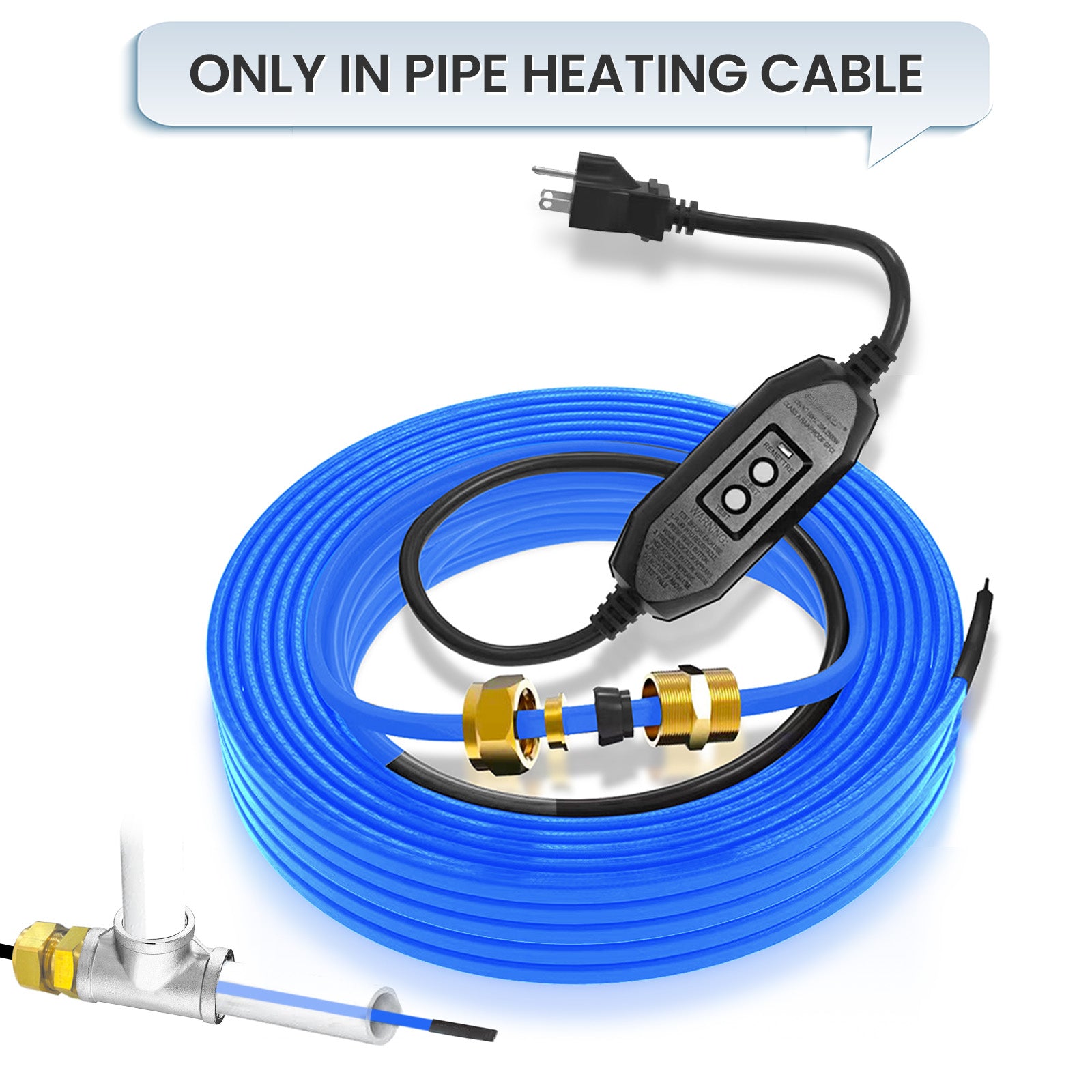
The YeloDeer In-Pipe Heating Cable is designed to help protect pressurized water supply lines from freezing in winter. Installed directly inside the pipe, this self-regulating heating cable provides reliable freeze protection for cabins, well water lines, seasonal homes, farm water systems, and other exposed or hard-to-insulate water lines.

Unlike external heat tape, an in-pipe heating cable delivers heat from inside the water line, making it a practical solution when the pipe is buried, exposed to extreme cold, or difficult to wrap from the outside.

Choose the Right Option

1. Cable Only: Choose Cable Only if you already have a compatible controller, prefer manual operation, or only need the in-pipe heating cable itself.

Please note: when used without a controller, the cable will continue to operate while plugged in. The self-regulating heating cable adjusts its heat output based on the surrounding temperature, but it does not fully turn itself off.

For easier winter operation, better energy control, and automatic temperature-based switching, we recommend using this cable with a compatible temperature controller. Customers who purchase the Cable Only option can also buy the controller separately at any time.

2. Cable & Controller Kit: Choose Cable & Controller Kit if you want more convenient automatic temperature control and improved energy efficiency. This kit is recommended for seasonal use, long-term winter operation, and customers who want the system to turn heating on and off based on temperature settings.

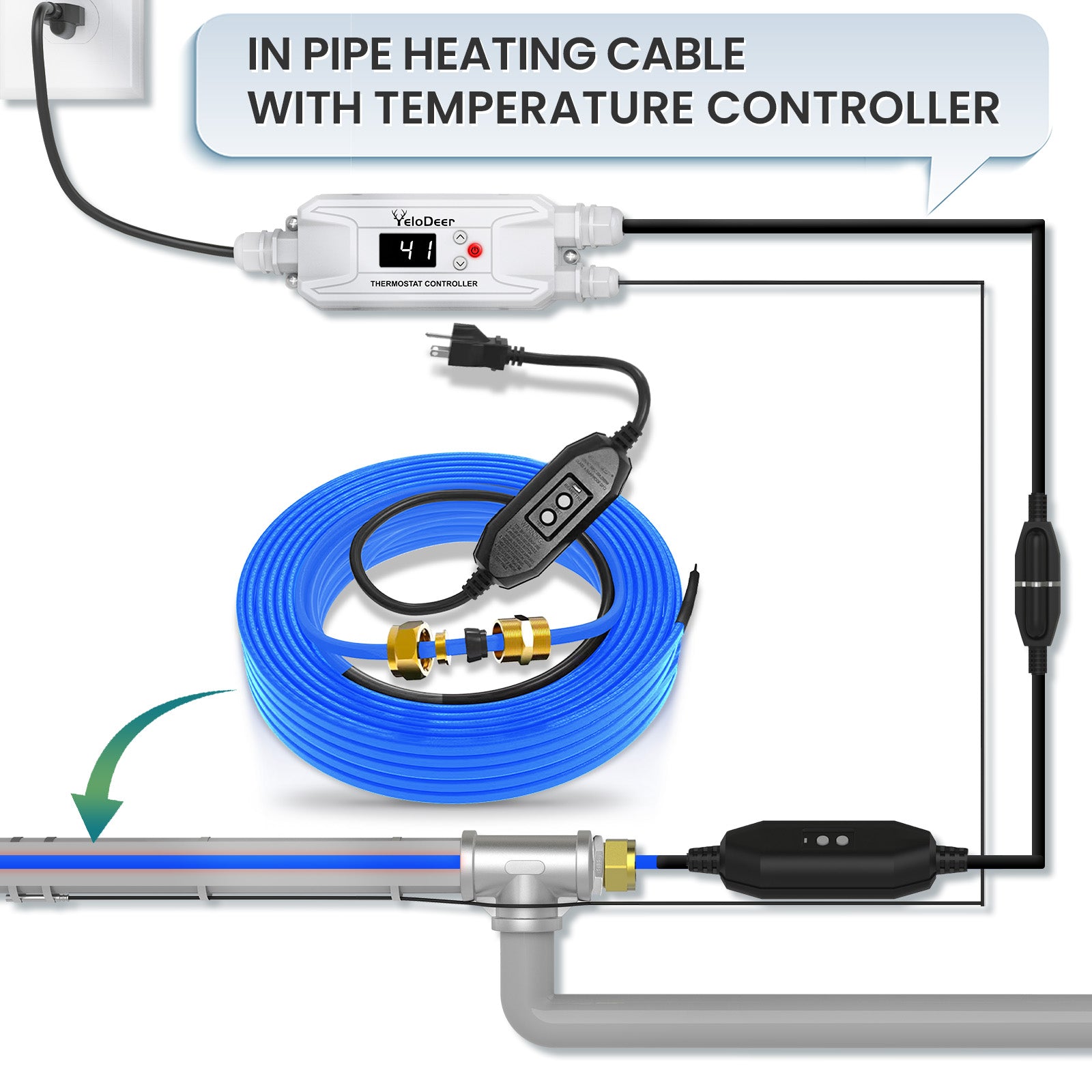
The kit includes the heating cable, a compatible temperature controller, and multiple adapter sizes to help fit common pipe connection needs.

For more details on the differences between our pipe heating solutions, check our blog:  How to Choose the Right Heat Cable for Your Pipes

Before You Order

Please confirm the following before purchase:
1. Your pipe size and fittings can provide a minimum inner opening of 17mm / 0.67 in.
2. The cable can enter through a proper pipe entry point, such as a T-fitting or compatible adapter.
3. The pipe does not contain sharp 90-degree or 45-degree elbows that may block cable insertion.
4. You have measured the full length of pipe that needs freeze protection.
5. For custom length, long runs, or 240V requirements, please select the Custom option or contact us before ordering.

For drain, sewer, sump, or wastewater applications, we recommend using a dedicated YeloDeer In-Drain Heating Cable instead.


Applications & Compatibility

Recommended Applications

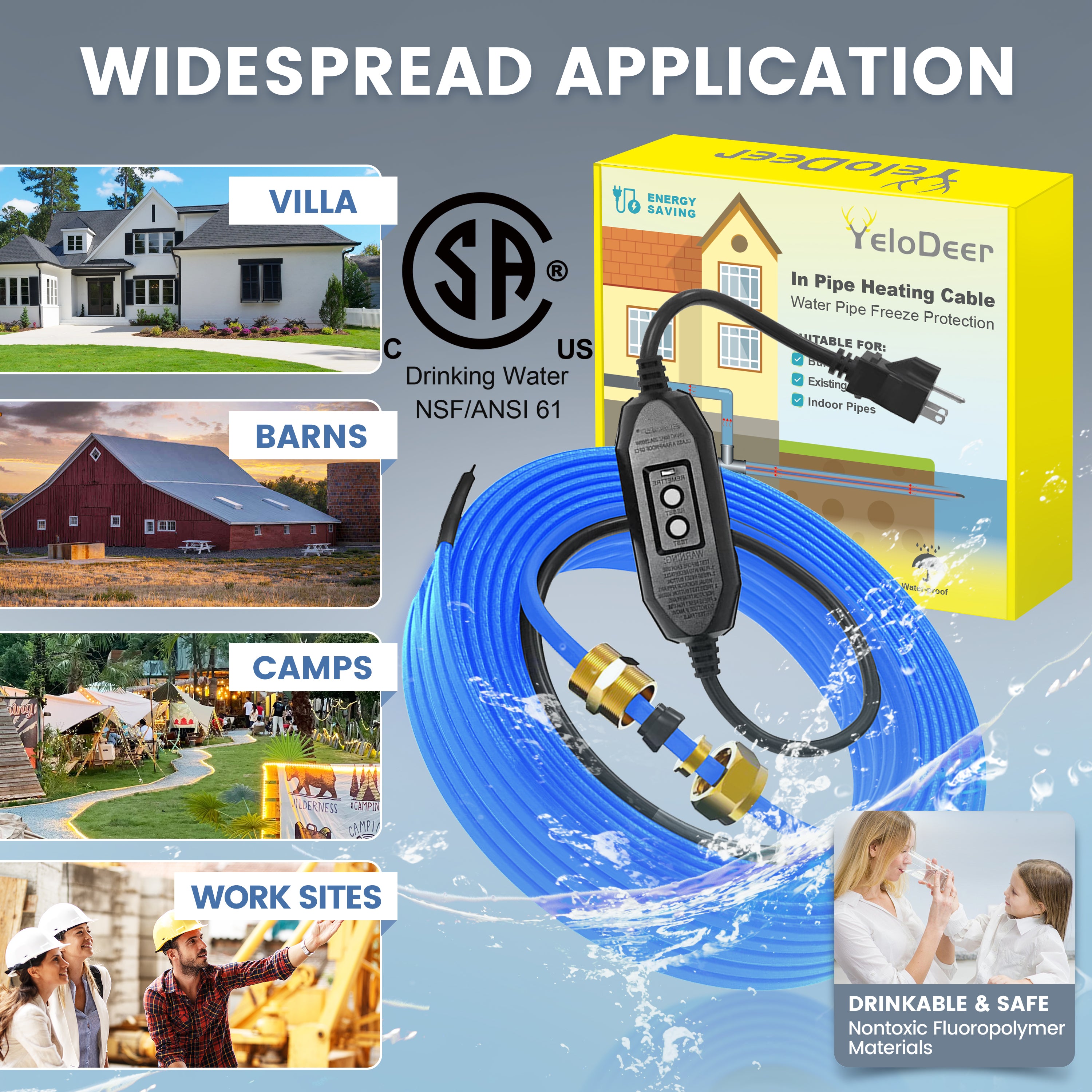
This in-pipe heating cable is suitable for:
Pressurized water supply lines
Potable water pipe freeze protection
Cabin water lines
Well water lines
Lake house or seasonal home water lines
Farm and livestock water systems
Outdoor or exposed water pipes
Above-ground water lines with insulation
Water lines that are difficult to protect with external heat tape

Pipe Compatibility

This product is designed for pipes 3/4 in and larger, but the actual fitting opening must be checked before installation.

Important: some 3/4 in pipes or fittings may narrow at connectors, elbows, valves, or adapters. Please make sure the cable path maintains at least 17mm / 0.67 in inner diameter to allow the cable to pass through properly.

Not Recommended For

This product is not recommended for:
Sharp 90-degree or 45-degree elbows
Pipes with blocked or unknown internal routing
Pipes without a suitable cable entry point
Pipes smaller than the required minimum inner diameter
Applications where the cable may be forced through tight fittings or sharp turns

For Drain or Sewer Pipes

Although some customers ask about using in-pipe heat cable for drainage applications, pressurized water lines and drain/sewer lines have different requirements.

For open-ended, low-pressure, non-potable drain or wastewater systems, please choose a dedicated YeloDeer In-Drain Heating Cable for a better fit and more cost-effective solution.

Specifications & Sizing

Key Specifications

Product Type: Self-regulating in-pipe heating cable
Application: Pressurized water pipe freeze protection
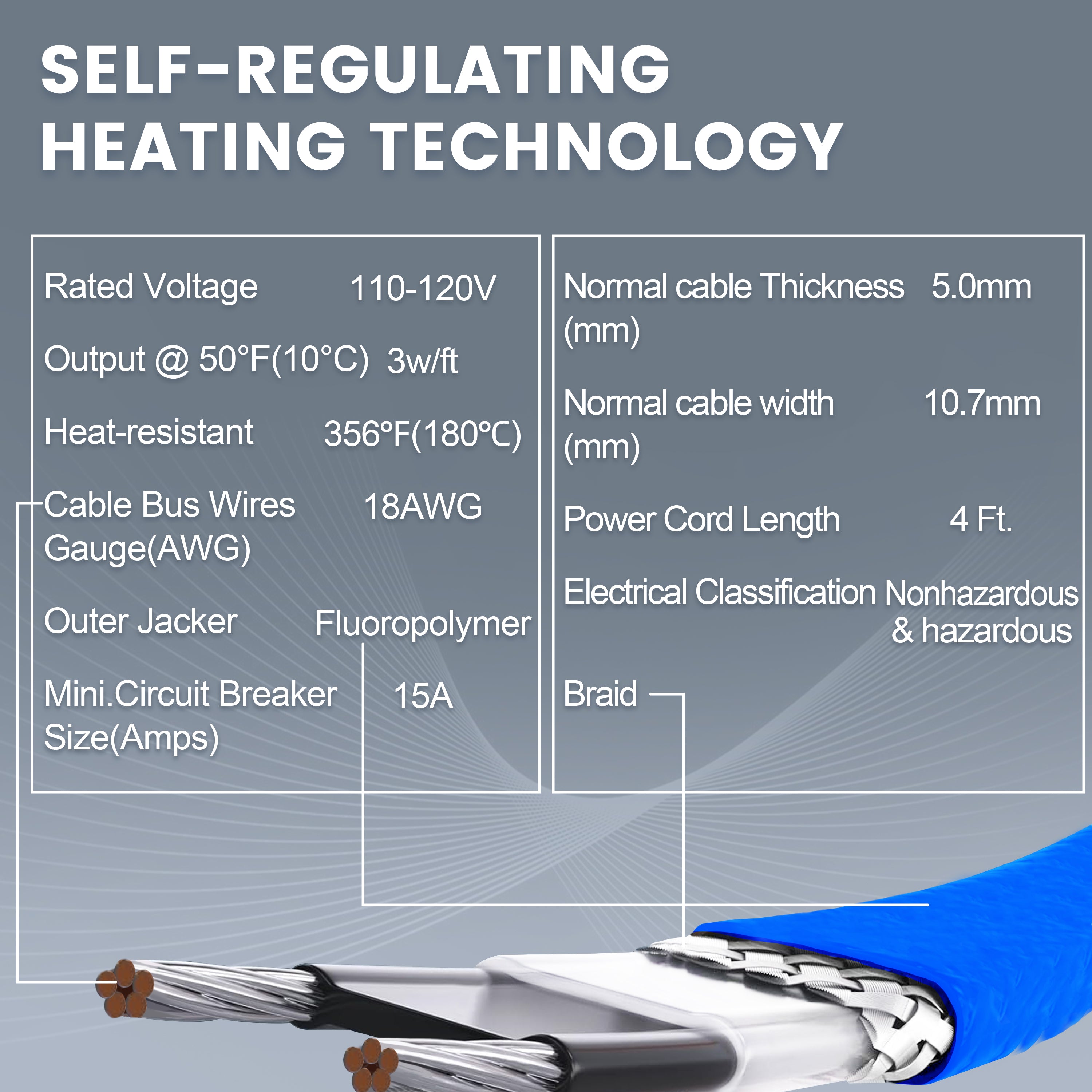
Standard Voltage: 120V
Custom Voltage: 120V / 240V available by custom order
Heat Output: 3W/ft at 50°F
Maximum Stable Cable Temperature: 60°C / 140°F
Pressure Rating: 230 PSI max
Jacket: Food-grade fluoropolymer jacket
Certification: CSA certified
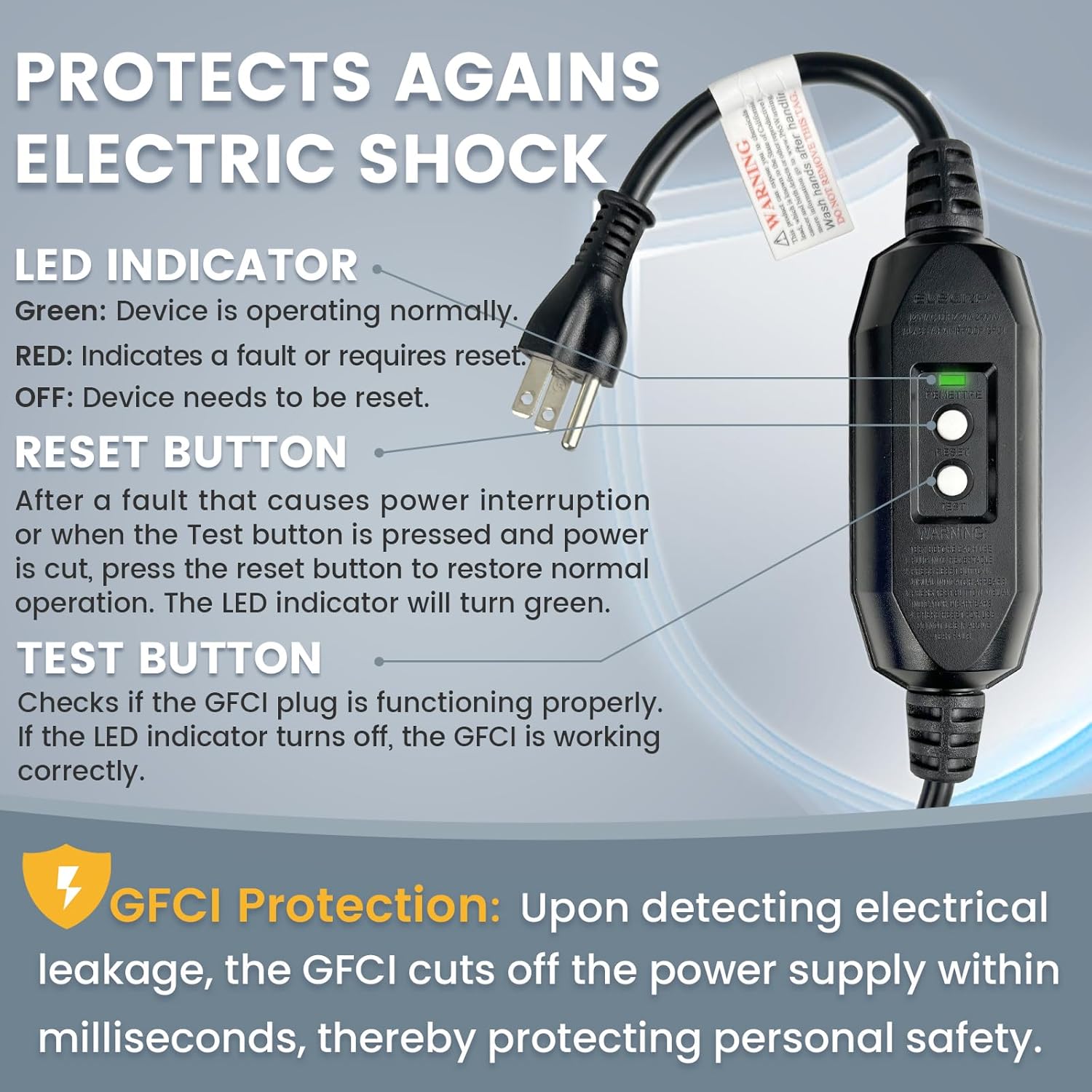
Electrical Protection: GFCI plug
Minimum Required Inner Opening: 17mm / 0.67 in
Suitable Pipe Size: 3/4 in and larger, depending on actual fitting ID
Available Lengths: Standard lengths and custom lengths available

How to Choose the Right Length

Measure the full length of the pipe section that needs freeze protection. The heating cable should cover the freeze-prone section from the entry point to the area where freezing is likely to occur.

For best results:
Do not guess the pipe length.
Do not choose a much longer cable than needed.
Check the full cable path before ordering.
For long pipe runs, confirm whether fish tape or puller assistance is needed.
For custom layouts, send us your pipe length, pipe size, voltage requirement, and photos before purchase.

When to Choose Custom

Select the “Custom” option if you need:
A non-standard length
240V specification
A long-distance pipe run
A special project requirement
Help confirming length, voltage, or fitting compatibility

After a custom order is placed, our team will contact you by email to confirm the required length, voltage, and installation details.

Installation & Accessories

Installation Overview

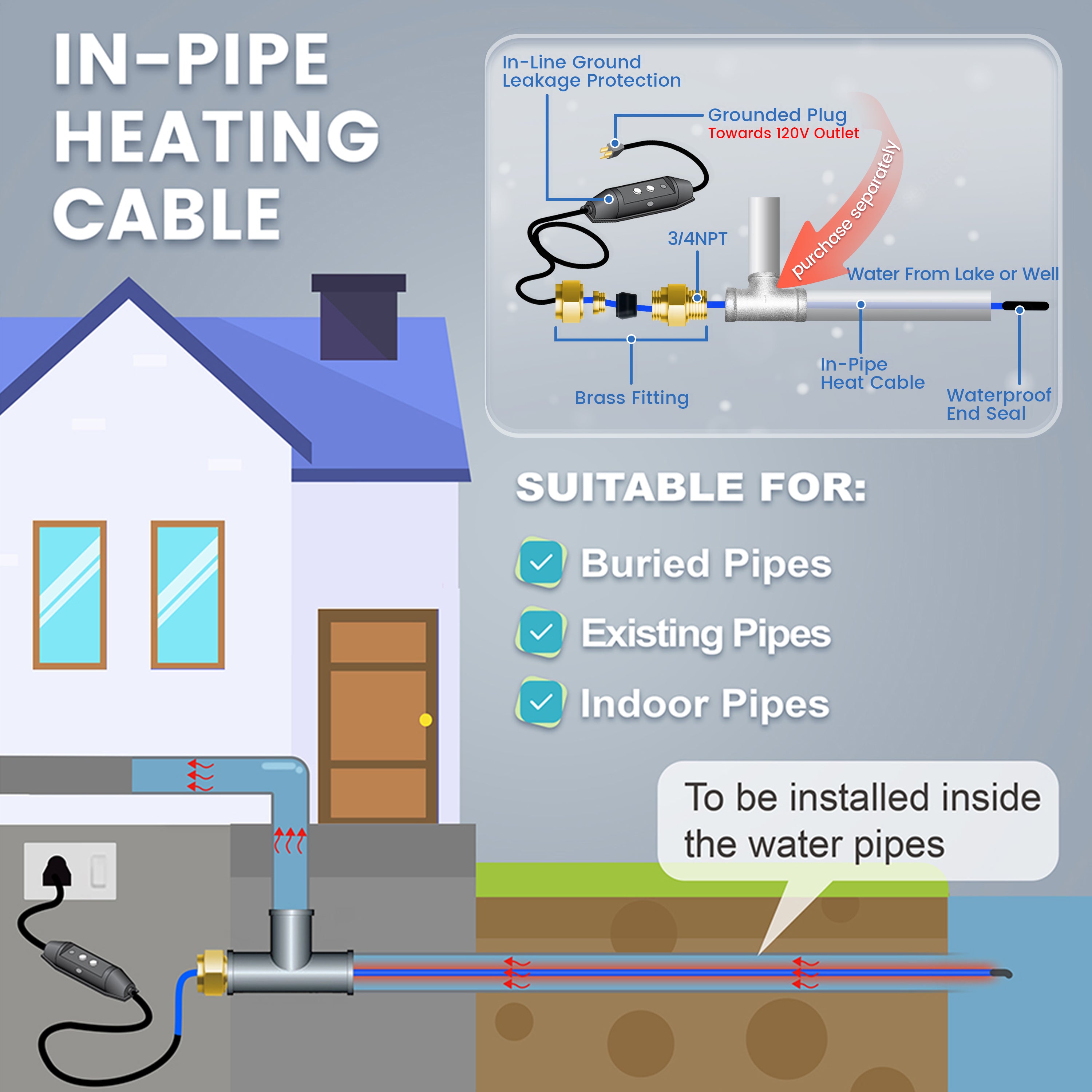
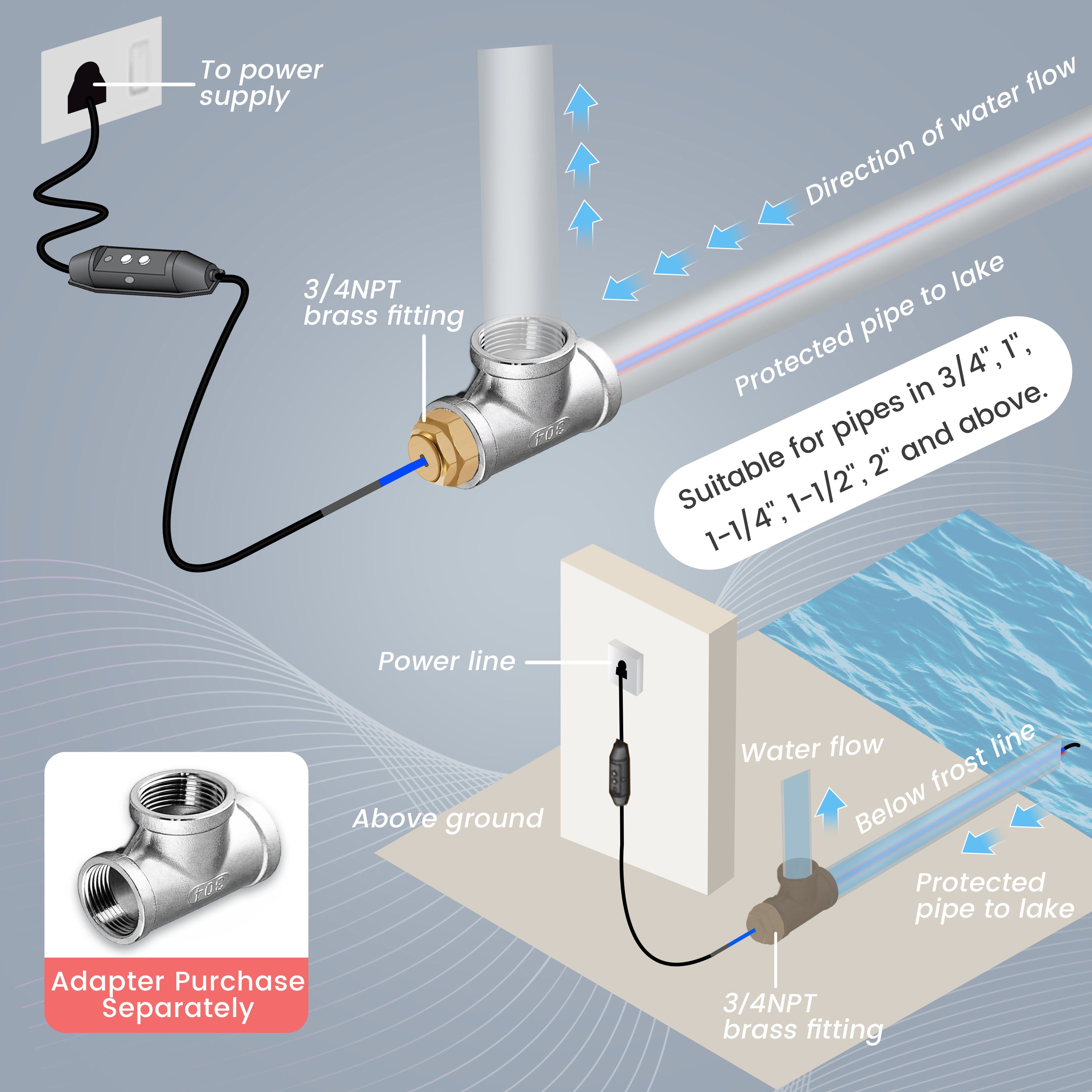
This in-pipe heating cable is installed through a suitable pipe entry point, such as a T-fitting, Y-fitting, or compatible adapter. The cable is inserted into the water line to protect the pipe from freezing from the inside.

Basic installation steps:

1. Identify the pipe section that needs freeze protection.
2. Shut off the water supply before installation.
3. Install a proper pipe entry fitting or adapter.
4. Confirm the minimum 17mm / 0.67 in inner opening.
5. Insert the heating cable into the pipe carefully.
6. Avoid forcing the cable through sharp bends or restricted fittings.
7. Connect the GFCI plug to a properly protected outlet.
8. If using the controller kit, place the sensor correctly and set the desired temperature range.

Important Installation Notes

* Do not force the cable through sharp elbows.
* Do not install through fittings with reduced inner diameter.
* Do not cut or shorten a standard plug-in cable unless the product instructions specifically allow it.
* Use proper insulation on exposed pipe sections to improve freeze protection and reduce energy use.
* For long pipe runs, fish tape or puller assistance may be required.
* For uncertain layouts, contact us before installation.

Accessories and Kit Options

Depending on your pipe system, you may need:
* T-fitting or Y-fitting
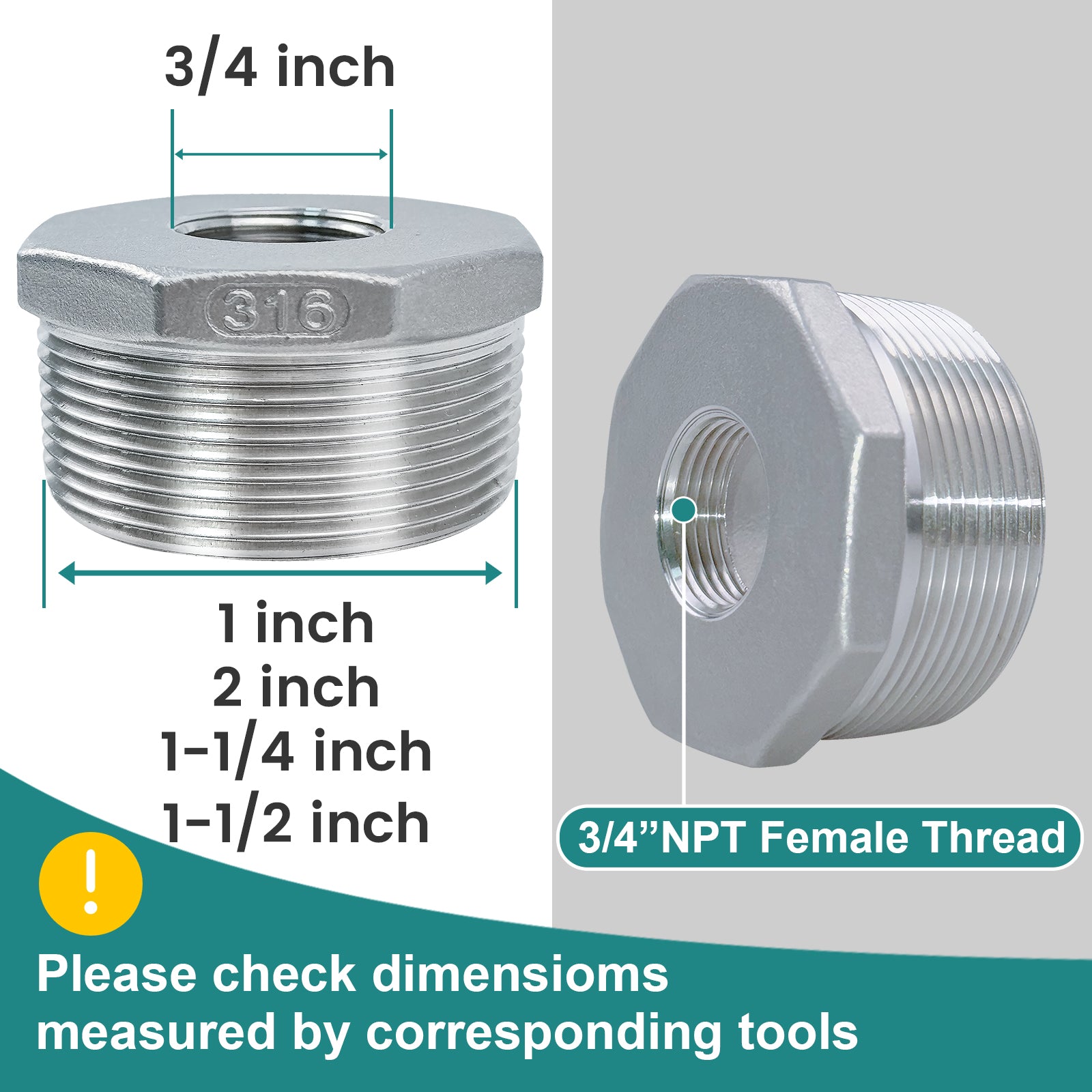
* NPT adapter
* Hose barb fitting
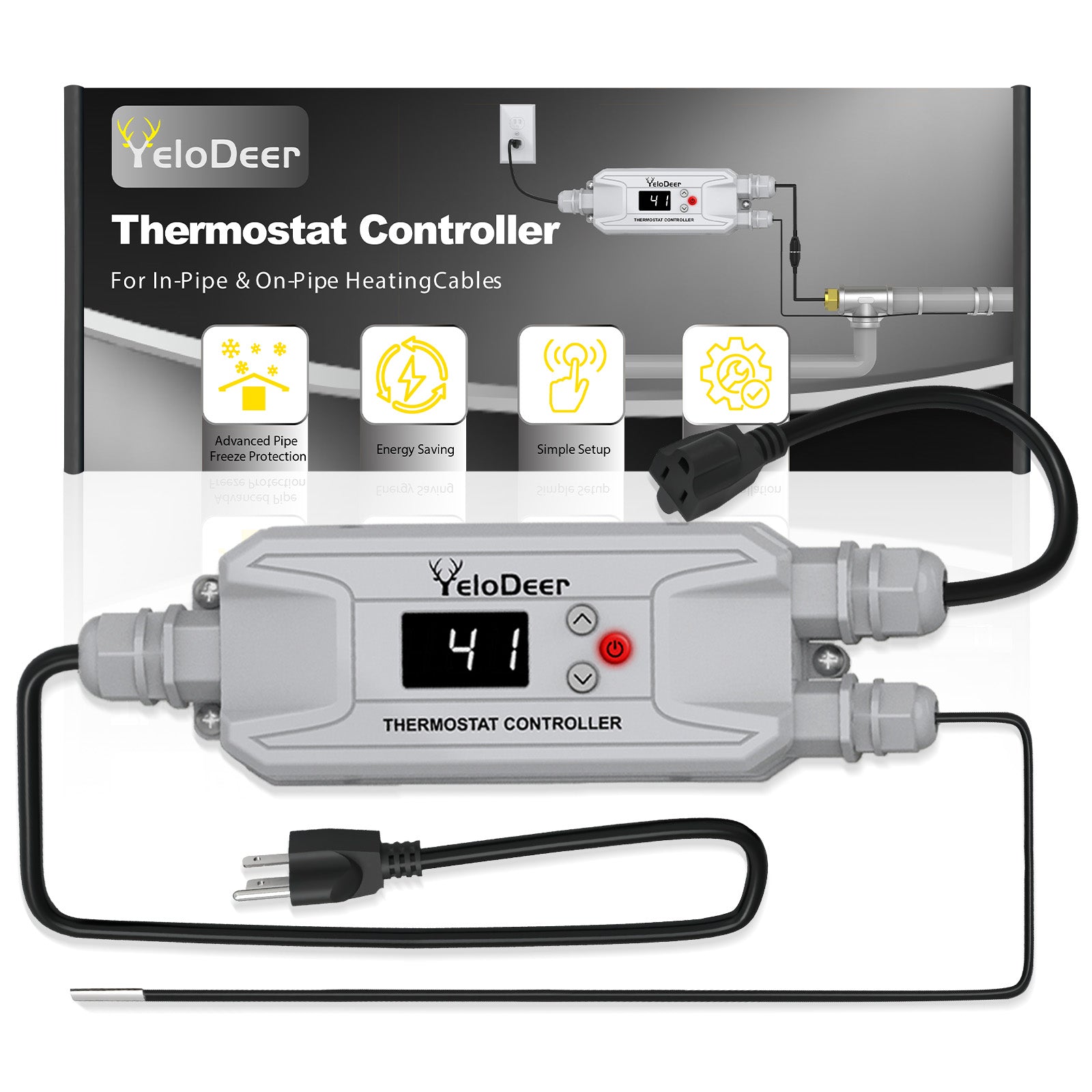
* Temperature controller
* Fish tape
* Pipe insulation
* Compatible clamps or connection hardware

Cable Only vs Cable & Controller Kit

Cable Only is suitable when you already have a compatible controller or prefer to manage operation manually.

Cable & Controller Kit is recommended when you want automatic temperature control, easier winter operation, and better energy efficiency. The controller helps turn the heating cable on and off based on temperature settings instead of leaving the cable powered continuously.

FAQ & Resources

Frequently Asked Questions

1. Can this heating cable be installed inside a drinking water pipe?
Yes. This product is designed for pressurized water supply lines and uses a food-grade jacket suitable for potable water pipe freeze protection.

2. Do I need a T-fitting or adapter?
In most installations, yes. The cable needs a proper pipe entry point, such as a T-fitting, Y-fitting, or compatible adapter. Please confirm your pipe size and fitting type before ordering.

3. What pipe size is required?
This product is designed for pipes 3/4 in and larger, but the most important requirement is the actual inner opening. The cable path must maintain at least 17mm / 0.67 in inner diameter.

4. Can this cable pass through elbows?
It is not suitable for sharp 90-degree or 45-degree elbows. Gradual bends may work, but the cable should never be forced through tight or restricted turns.

5. Can I cut the cable shorter?
For standard plug-in products, please choose the correct length before purchase. If you need a special length, select the Custom option or contact us before ordering.

6. Does this cable need a controller?
A controller is not strictly required, but it is highly recommended. Without a controller, the cable will keep operating while plugged in. A controller helps reduce energy use and provides automatic temperature-based operation.

7. Does self-regulating mean the cable turns off by itself?
No. Self-regulating means the cable adjusts its heat output based on the surrounding temperature. It reduces output in warmer areas and increases output in colder areas, but it does not fully shut off by itself. To fully stop heating, disconnect power or use a controller.

8. Can this be used for drain, sewer, or sump pipes?
For drain, sewer, sump, or wastewater applications, we recommend using a dedicated YeloDeer In-Drain Heating Cable. It is better suited for open-ended, low-pressure, non-potable drainage systems.

9. Is it safe if the pipe is dry or empty?
The self-regulating cable reaches a stable maximum temperature and is designed to reduce overheating risk. However, installation should always follow the product instructions and the cable should be used only in suitable applications.

10. What should I do if I am not sure which length or fitting I need?
Please contact us before ordering. Send your pipe size, pipe length, photos of the installation area, voltage requirement, and a brief description of your application. Our team can help you choose the right option.

Need more help? Visit our full FAQ page or contact us at yelodeer@yelodeer.com

Real Customer Installations

See how YeloDeer customers use our in-pipe heating cable in real winter pipe freeze protection projects. These installation photos show different pipe layouts, fittings, adapters, and water line setups, helping you better understand how the cable can be installed in real-world conditions.

Every pipe system is different. Before ordering or installing, please confirm your pipe size, fitting type, cable entry point, and whether the cable path includes sharp elbows or restricted fittings. If you are not sure which setup is right for your application, please send photos of your pipe layout to yelodeer@yelodeer.com. Our team will help you review the installation details and choose the right option.

Photos are provided for reference only. Always follow the product manual and confirm compatibility with your pipe system before installation.


In-Pipe Heating Cables

Common Questions

This FAQ section is compiled from real customer inquiries.

If you have any other questions about this product, whether related to its design, installation, or application, feel free to ask directly in the QA section at the bottom of the page to get your answers.

You can also contact us via email at yelodeer@yelodeer.com.

We’re here to help!

IP-YIP.png

Both are designed for pressurized supply lines, but they differ in how the heating cable enters the pipe, how they adapt to pipe sizes, and how they affect water flow:

Entry Method

  • Y Fitting: Uses a Y-pipe with hose barbs sized for 3/4 in, 1 in, and 1-1/4 in pipes. Beyond 1-1/4 in, it becomes unsuitable because the 1 in throat creates a bottleneck.
  • T Fitting: Requires an additional T-pipe fitting and an adapter. With the adapter, it can accommodate a wider range of pipe sizes, making it more flexible.

Effect on Flow

  • Y Fitting: Maintains a straight flow path; no change in the water direction.
  • T Fitting: Alters the flow direction into an L-shape, since the cable enters through the side branch of the T.

Best For

  • Y Fitting: Quick installs on small to mid-sized pipes (≤1-1/4 in) where keeping a straight flow is important.
  • T Fitting: Larger or mixed pipe systems where you need more flexibility in pipe sizes and installation points, even if the flow path changes.

No, this in-pipe heating cable is not suitable for sharp bends like 90-degree or 45-degree elbows. If your pipe has such abrupt turns, you'll need to replace those sections with smoother, sweeping bends to allow the cable to pass through easily.

Yes, it can be used, but we also offer heating cables specifically designed for sewage and wastewater pipes. The main difference between this in-pipe cable and the dedicated version is that the latter is not as pressure-resistant. However, it works perfectly for open-ended sewage pipes or drainage channels, and it’s also more cost-effective.

For more details, please check the link--In Drain Pipe Heating Cable.

No, you generally do not need to reset the GFCI (Ground Fault Circuit Interrupter) after a regular power outage. The GFCI only requires a manual reset if it detects a ground fault (leakage).

In the event of a standard power outage, the GFCI should not trip, and once the power is restored, the system should resume operation normally unless a ground fault is detected at that time.

No, the heating cable can be inserted without directional limitations. It works effectively in either direction, making it ideal for both water supply and drainage systems, no matter the direction of water flow.

Applicable for:

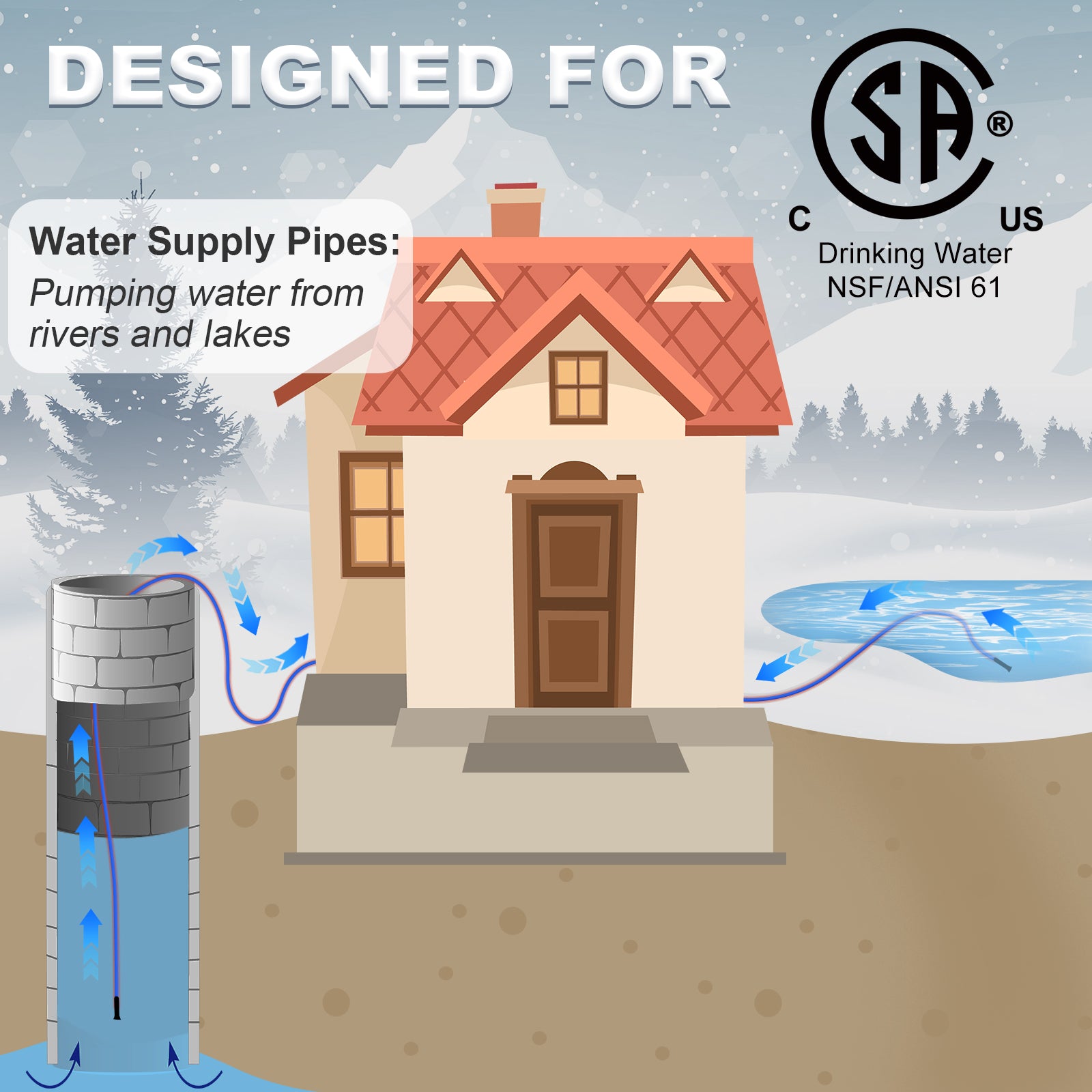
  • Supply Pipes: Pumping water from lakes or rivers.
  • Drainage Pipes: Removing water from inside your home.

Yes, this product is designed for use with pipes in 3/4-inch and above. However, please ensure there are no sections of your pipe, such as at fittings or connectors, where the inner diameter is reduced to less than 17mm (0.67 inches). If such restrictions exist, the heating cable may not fit properly.

Related Blogs on This Product

YeloDeer In Line Heating Cable

Questions & Answers

Have a Question?

Ask a Question
  • I have approximately 40 feet of 1 1/2 inch pipe running between two buildings. The water line connection is pretty straight. The pipe runs underground and recently froze due to extreme cold. The plumbers thawed it out but now we are looking for a solution to keep it from happening again. Will this line dramatically (or materially) reduce the volume of water going to the second building? Second, the cold spot is in the middle of the "run" between the two buildings. Can the sensor be placed in the middle and the run continue on to the end of the run? Third, is there a "smart" feature that I can log on to and see what the water temp is? Finally, is it one end only, meaning I don't need to do anything at the other end?

    Dear Mr. Drapeau,

    Thank you for your questions regarding our Food-Grade In-Pipe Heating Cable. We are happy to provide the following clarifications:

    Regarding water flow volume: A 1 1/2 inch pipe will not dramatically or materially reduce the volume of water going to the second building. We have not received any customer feedback indicating flow restrictions with this pipe size when using our heating cable.

    Regarding sensor placement: The sensor probe is designed to be placed at the coldest spot of the pipe run. It can absolutely be placed in the middle of the run between the two buildings, and the heating cable can continue to the end of the pipe as needed.

    Regarding "smart" features: Our intelligent thermostat controls the heating cable based on the pipe or air temperature detected by the sensor, activating it when temperatures drop to a set threshold. While it effectively prevents freezing, it does not currently support direct logging or remote viewing of water temperature.

    Regarding installation: Our heating cable is designed for single-end connection. This means all electrical connections and controls are at one end, and no additional work is required at the opposite end of the pipe run.

    We hope this information helps you make an informed decision. Please let us know if you have any further questions or need additional details.

    Best regards,


  • Hello can I leave my heating cable always plugged in Thank- you


    Hello Floyd,

    Thank you for reaching out.

    You can keep the heating cable plugged in if you have anti-freezing requirements.

    However, when the weather is warm and there is no need for pipe-freezing protection,

    please unplug the cable to ensure safety and energy efficiency.

    Thanks and regards,

    Demi

  • What diameter is the heating cable?

    The heating cable diameter is 10.7*5.0mm (0.42*0.2in).

  • How flexible is the inline heating cable. Can I feed it through a 1" 90 degree fitting

    Thanks for your question!

    No, this in-pipe heating cable is not designed to bend around sharp 90-degree or 45-degree elbow fittings. If your pipe has abrupt elbows, they need to be replaced with sections that create sweeping bends to allow the cable to pass smoothly. Important Notice: Forcing the cable through sharp elbows can damage the end seal, potentially causing water leakage. Many leakage issues result from improper installation, so please ensure careful installation.


  • At what temp does the line kick in and heat up

    Thank you for your question! Since this product does not have a built-in thermostat, it begins heating as soon as it’s plugged in, regardless of the external temperature. However, due to its self-regulating feature, it adjusts the output power based on the surrounding temperature—when the temperature is higher, the output is lower, though it’s still in a heating state.

    If you’d like more precise temperature control, we also offer a bundle that includes a Pipe Heat Tape Thermostat, allowing you to manually set the temperature at which it turns on and off.

  • Is the 6’ power cord in addition to the 15’ measurement of the actual heat cable, or included with the entire measurement(6’ power cord, 9’ heat cable)?

    The length indicated on our product pages refers only to the length of the heating cable and does not include the power cord.

    However, please note that for the in-pipe heating cable you inquired about, the power cord is actually 4 feet long.