Free project planner
Calculate the cable length for your roof
Enter your eave, gutter and downspout measurements to estimate cable length, compare YeloDeer cable options and save a project plan.
Calculate Cable Length →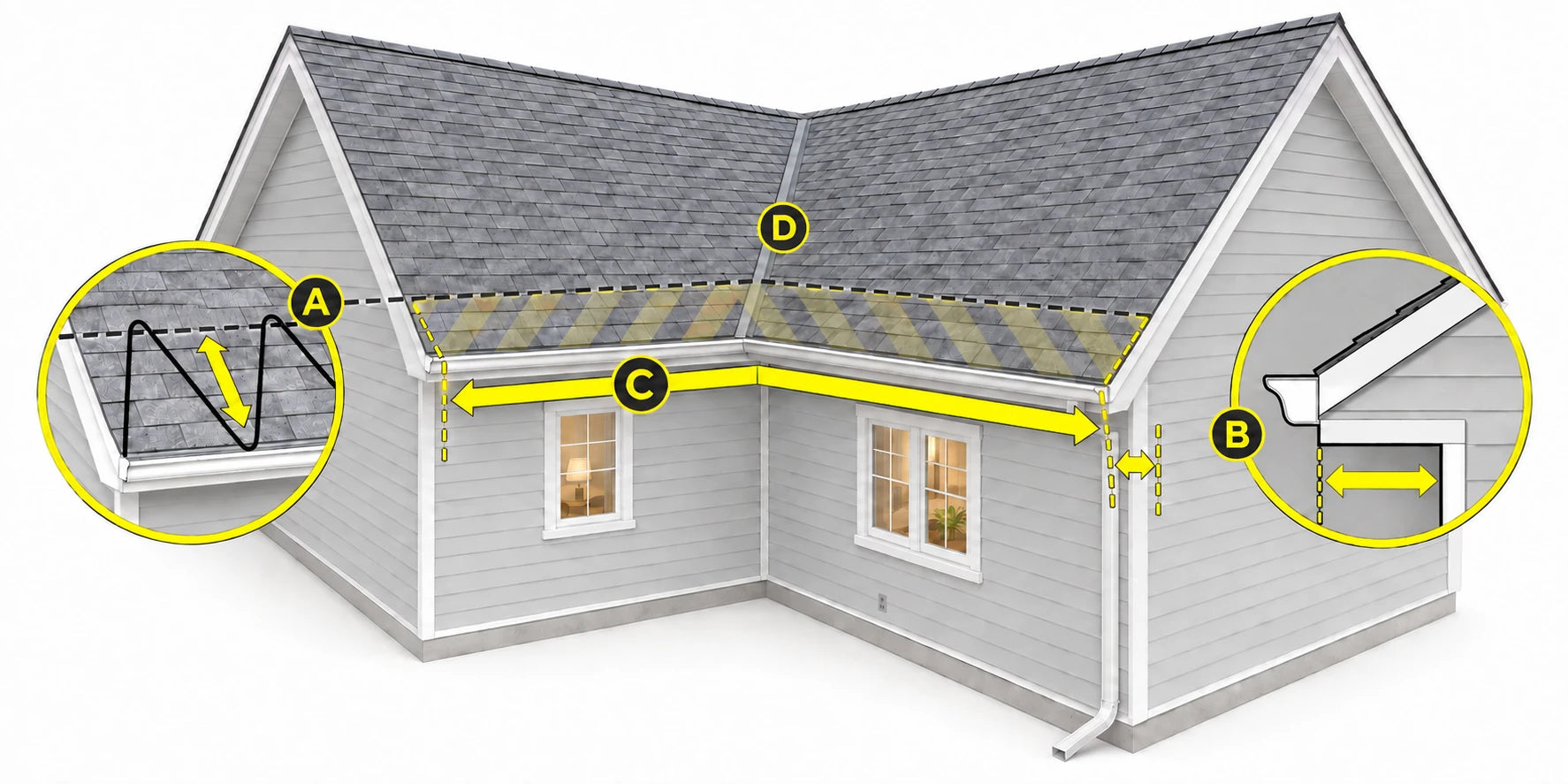
Quick Answer
To calculate roof deicing cable length, do not measure only the roof edge. A practical roof heat cable layout should cover the full drainage path: roof edge zigzag area, roof extension into the gutter, gutter run, and downspout run.
Use this formula as a starting point: Total Cable Length = A + B + C + D. For example, a 15 ft roof section with a 12-inch overhang, 15 ft gutter, and one 15 ft downspout may require about 80.5 ft of heating cable, so ordering a 100 ft kit or roll is usually more practical.
Ordering the wrong length of roof deicing cable is one of the most common reasons an ice dam prevention system underperforms. If the cable only covers the roof edge but not the gutter or downspout, meltwater may still refreeze before it reaches the ground.
For better winter performance, the cable should help maintain a continuous drainage path from the warm roof edge area, through the gutter, and down the downspout.
The A+B+C+D Roof Deicing Cable Formula
Before choosing a cable length, divide the project into four zones. This keeps the measurement simple and helps prevent under-ordering.
Total Cable Length = A + B + C + D
Important: roof deicing cable does not need to cover the entire roof. The goal is to create and maintain drainage channels in the most ice-prone areas.
A. Calculate the Roof Edge Zigzag Area
The roof edge zigzag area is usually the largest part of the cable layout. The required length depends on the roof edge length, eave overhang depth, roof material, and cable spacing pattern.
Zone A = Roof Edge Length × Multiplier
For a standard shingle roof, use the following multiplier reference as a planning starting point:
| Eave Overhang | Typical Multiplier | Example for 15 ft Roof Edge |
| 12-inch overhang | 2.8 | 15 ft × 2.8 = 42 ft |
| 24-inch overhang | 3.8 | 15 ft × 3.8 = 57 ft |
| 36-inch overhang | 4.8 | 15 ft × 4.8 = 72 ft |
For standing seam metal roofs, the multiplier may differ. For a 12-inch overhang, a typical multiplier may be around 2.4 or 2.8 depending on the approved layout and roof profile.
B. Calculate the Roof Extension
The roof extension allows the heating cable to transition from the roof edge into the gutter. Without this transition, meltwater can leave the heated roof channel and refreeze before entering the gutter.
Zone B = Roof Edge Length × 0.5
For example, if your roof edge is 15 ft long:
C. Calculate the Gutter Run
The gutter run covers the horizontal drainage channel. This helps reduce the chance of meltwater refreezing inside the gutter before it reaches the downspout.
Zone C = Total Gutter Length
In most standard layouts, the gutter run uses a 1:1 ratio. If the gutter length is 15 ft, the gutter portion of the cable layout is also 15 ft.
Customer tip: do not skip the gutter run. A heated roof edge cannot fully support drainage if the gutter freezes solid.
D. Calculate the Downspout Run
The downspout run is critical because ice inside the downspout can block the exit and cause water to back up into the gutter.
Zone D = Total Downspout Height + 1 ft
The extra 1 ft helps extend the cable toward the bottom discharge area so meltwater has a clearer path out of the downspout.
Looping note: if you plan to loop the cable down and back up inside the downspout for additional heat, double the downspout length portion for that specific run.
Realistic Example: 15 ft Roof Section
Now let’s calculate a common residential setup: a 15 ft roof edge with a 12-inch overhang, a 15 ft gutter, and one 15 ft downspout.
| Zone | Calculation | Result |
| A. Roof Edge Zigzag Area | 15 ft × 2.8 | 42.0 ft |
| B. Roof Extension | 15 ft × 0.5 | 7.5 ft |
| C. Gutter Run | 15 ft | 15.0 ft |
| D. Downspout Run | 15 ft + 1 ft | 16.0 ft |
| Total Required | 42.0 + 7.5 + 15.0 + 16.0 | 80.5 ft |
Recommended Order for This Example
For an 80.5 ft calculated layout, a 100 ft YeloDeer roof deicing kit or bulk cable roll is usually the more practical choice.
This gives you enough cable for the required drainage path while avoiding the risk of coming up short during installation.
Explore YeloDeer Roof De-Icing SolutionsPre-Cut Kits vs. Bulk Cut-to-Length Rolls
After calculating the total cable length, the next step is choosing the right product format. YeloDeer offers options for both simpler residential layouts and larger professional projects.
Installation reminder: cut-to-length roof deicing cable requires the correct termination, end seal, power connection, ground-fault protection, and installation method. Follow the product instructions and local electrical requirements.
Common Measuring Mistakes to Avoid
Most cable length problems come from missing one part of the drainage path. Before ordering, double-check these common mistakes.
Do not guess your cable length. A roof deicing system needs the right layout, correct cable length, proper accessories, and safe electrical design to perform well during winter conditions.
When Contractors Should Use Bulk Cable Rolls
For contractors, facility teams, and wholesale partners, accurate material estimation affects both system performance and project profitability.
Bulk cut-to-length rolls are often the better choice for complex rooflines because they allow each zone to be cut to the exact required length. This can reduce wasted cable and make the layout easier to adapt to multiple roof sections.
For Contractors & Wholesale Partners
YeloDeer provides professional-grade self-regulating roof deicing cable options for residential and commercial project scales, including 100 ft, 250 ft, and 500 ft rolls.
Need help estimating materials for a project? Share your roof edge length, overhang depth, gutter length, downspout count, downspout height, roof material, voltage requirement, and installation plan.
Contact Our Technical TeamFAQ
How do I calculate roof deicing cable length?
Use the formula Total Cable Length = A + B + C + D. A is the roof edge zigzag area, B is the roof extension into the gutter, C is the gutter run, and D is the downspout run.
Do I need to include gutters and downspouts?
Yes. If gutters or downspouts freeze, meltwater can back up even if the roof edge is heated. A good roof deicing layout should help maintain the full drainage path.
What multiplier should I use for the roof edge?
For standard shingle roofs, a common planning reference is 2.8 for a 12-inch overhang, 3.8 for a 24-inch overhang, and 4.8 for a 36-inch overhang. Always confirm the final layout with the product instructions.
How much cable do I need for a 15 ft roof edge?
For a 15 ft roof edge with a 12-inch overhang, 15 ft gutter, and one 15 ft downspout, the estimated total is about 80.5 ft. A 100 ft kit or roll is usually a practical order size.
Should I order the exact calculated length?
Usually no. Ordering the exact calculated length can leave little room for layout variation, roof details, clips, routing, or installation adjustments. Choose the next appropriate kit or roll size.
When should I use bulk cut-to-length roof heating cable?
Bulk rolls are useful for projects over 100 ft, contractor work, complex rooflines, multiple downspouts, commercial buildings, or layouts that need different cable sections cut to specific lengths.
Can roof deicing cable guarantee no ice dams?
No. A properly selected and installed roof deicing cable can help reduce ice dam risk and maintain drainage channels, but performance also depends on roof design, insulation, ventilation, snow load, weather, layout, and maintenance.
The Bottom Line
Roof deicing cable length should be calculated by the full drainage path, not just the visible roof edge.
Use the A+B+C+D method: roof edge zigzag area, roof extension, gutter run, and downspout run. For a standard 15 ft example with a 12-inch overhang, the estimated total is about 80.5 ft, making a 100 ft kit or roll a practical choice.
For simple residential projects under about 100 ft, pre-cut kits are often easier. For larger, complex, or professional projects, bulk cut-to-length rolls can offer better flexibility and material efficiency.
Need Help Measuring Your Roof Deicing Cable?
Tell us your roof edge length, overhang depth, gutter length, number of downspouts, downspout height, roof material, and whether you need a pre-cut kit or bulk roll. The YeloDeer team can help you review the right cable length for your project.
Explore YeloDeer Roof De-Icing Solutions Contact Our Technical Team