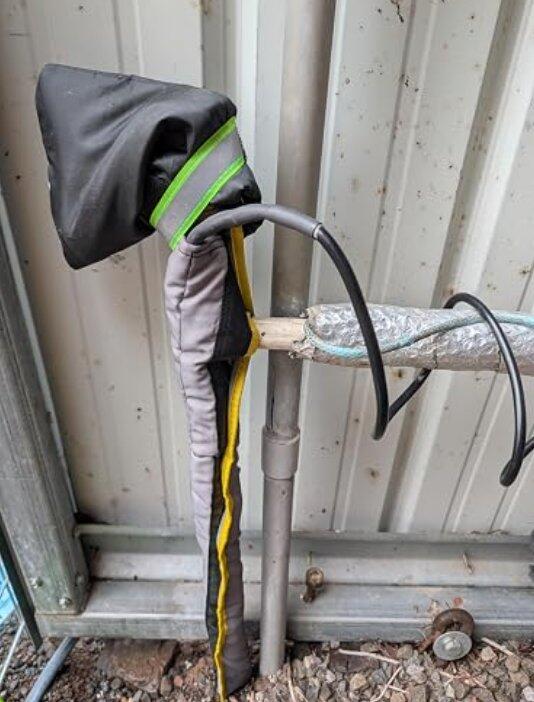
Trimmable Self-Regulating Pipe Heating Blanket for Hydrants, Valves & Irregular Pipes
YeloDeer 6W/ft pipe heating blanket combines self-regulating heat, insulation, and a wrap-style fabric cover for freeze-prone areas that are difficult to protect with narrow pipe heat tape. It is designed for yard hydrants, outdoor faucets, exposed pipes, valves, elbows, bends, and other short or irregular pipe sections.
The integrated thermostat automatically controls power in cold conditions, while the self-regulating heating cable adjusts heat output as temperature changes. The blanket fabric can be carefully trimmed in approved non-heating areas for a better fit around irregular shapes.
Self-Regulating Heat 6W/ft heating cable adjusts heat output as surrounding temperature changes.
Built-In Thermostat Turns on at approximately 38°F / 3°C and off at approximately 50°F / 10°C.
Trimmable Fabric Approved fabric areas may be trimmed carefully for valves, bends, and irregular shapes.
Heating + Insulation Integrated heating cable, insulation layer, waterproof Oxford fabric, and soft flannel lining.
Important: “Trimmable” does not mean the heating cable can be cut.
Trim only approved fabric areas where the heating cable is not present. Never cut the heating cable, thermostat, power cord, internal wiring, insulation structure, or heating element. If you cannot clearly identify a safe trimming area, do not trim the blanket.
Choose the Right Heating Blanket

Choose This Self-Regulating Blanket Best when the pipe or fitting is irregular, may be empty or dry at times, needs built-in thermostat control, or requires careful trimming of the blanket fabric for a closer fit.
Choose the Constant-Wattage Heat Trace Blanket Better for short, above-ground, water-filled pipes, faucets, hydrants, barrels, tanks, and simple wrap-around heating. It uses 14W/ft constant-wattage heating and cannot be trimmed.
For short water-filled pipe or fixture applications where a non-trimmable constant-wattage blanket is preferred, compare the YeloDeer Constant-Wattage Pipe Heat Trace Blanket →
Pipe Size & Fastening Guide
1 in and smaller: Use the built-in Velcro straps. 1-1/4 in and 1-1/2 in: Use the included zip ties for additional support. Larger than 1-1/2 in: Use two or more blankets connected by their Velcro edges. Irregular fittings: Position the blanket for close surface contact without sharp folds or compression.
Before You Order
Good Fit Above-ground hydrants, valves, elbows, faucets, exposed pipe, dry or intermittent-flow pipe sections, and irregular areas that benefit from wider heating coverage.
Not for These Applications In-pipe installation, underground burial, long-term submersion, sewer or drain heating, roof de-icing, leaking pipes, or locations where the blanket can be crushed, cut, chewed, or submerged.
Self-regulating and thermostat control are two different functions. The heating cable adjusts its heat output along the blanket as temperature changes. The built-in thermostat controls when power turns on and off based on the temperature around the thermostat.
Why Choose a Heating Blanket Instead of Standard Heat Tape?
Wider Surface Coverage A pipe warming blanket covers a broader area around hydrant heads, valves, elbows, and bulky fittings.
Heat + Insulation Together The integrated insulation layer helps retain heat around the protected section.
Easier Around Odd Shapes The wrap-style design is useful where spiral-wrapping a narrow heat cable would be difficult or uneven.
Expandable for Larger Pipes Multiple blankets can be joined by their Velcro edges to increase wrap width.


Recommended Applications
This self-regulating pipe heating blanket is designed for external freeze protection where wider contact and a wrap-style insulated design are more practical than standard narrow heat tape.
Hydrants & Water Fixtures
Yard Hydrants Barn Hydrants Outdoor Faucets Water Spigots
Irregular Pipe Areas
Valves Elbows Bends Large Fittings
Farm & Livestock Systems
Farm Water Lines Livestock Water Barn Plumbing Stable Water Lines
Utility & Seasonal Areas
Garage Pipes Basement Pipes RV Hoses Camper Water Lines
Compatible Pipe Materials
PEX PVC CPVC Copper Steel Galvanized Pipe Metal Hydrants Suitable Plastic & Metal Pipes
The surface must be clean, dry, undamaged, and safe to heat before the blanket is installed.
Dry or Empty Pipes
This self-regulating version is the preferred YeloDeer blanket option when a pipe may be empty, dry for long periods, or experience intermittent flow. Its self-regulating heating cable changes heat output as local temperature changes.
Do Not Use For
- Underground burial or areas that will be covered with soil
- Long-term submersion or standing-water installation
- Heating inside a pipe, sewer, or drain
- Roof, gutter, or downspout de-icing
- Cracked, leaking, damaged, or otherwise unsafe pipes
- Areas where the blanket may be crushed, punctured, cut, or sharply folded
- Locations where animals may chew or damage the fabric or cable
- Locations where the plug, thermostat, outlet, or connection may sit in water
Above-ground protection only. Wrapping the exposed portion of a yard hydrant will not correct a freezing problem located deeper underground. Identify the actual freeze point before choosing the product.
Before Installation
Identify the actual freeze-prone area Measure pipe or hydrant diameter Choose the required blanket length Confirm the correct fastening method Locate the heating cable before any trimming Confirm access to 110V / 120V AC power Protect the outdoor power connection Inspect the pipe and blanket for damage

Basic Installation
- Clean and dry the pipe, hydrant, valve, faucet, or fitting.
- Measure the area that requires freeze protection.
- Position the blanket so the heating area stays in close contact with the surface.
- For pipes 1 in and smaller, secure the blanket with the built-in Velcro straps.
- For 1-1/4 in and 1-1/2 in pipes, use the included zip ties for additional support.
- For larger pipe diameters, connect two or more blankets using their Velcro edges.
- If trimming is needed, locate the heating cable first and trim only an approved fabric area.
- Do not sharply fold, crush, puncture, or tightly compress the heating area.
- Position the thermostat where it can properly sense cold ambient conditions.
- Plug the blanket into a properly protected 110V / 120V outlet.
- Inspect the installation before severe freezing weather.
Critical Trimming Rules
Do Trim only excess fabric where you are certain no heating cable, sensor, wiring, splice, or electrical component is present.
Do Not Cut the heating cable, thermostat, power cord, internal wiring, heating element, or an area where the cable location cannot be clearly identified.
Outdoor Power Connection
Use a properly installed outdoor-rated outlet and a weatherproof in-use cover where required. Keep the plug, thermostat, outlet, and any extension-cord connection out of standing water, snow, and direct rain exposure.
Farm, Barn & Stable Installations
Secure the blanket so animals cannot reach or chew the cable or fabric. Keep it away from sharp edges, impact, bedding materials, and locations where routine animal movement may damage the installation.
Hydrant Freeze Protection Guide
Hydrant heads, valve bodies, risers, and transition areas can remain exposed even when the deeper supply pipe is below the frost line. For campground, RV park, farm, or multi-site hydrant projects, see the YeloDeer application guide.
Read the Campground Water Hydrant Freeze Protection Guide →
Understanding the Built-In Thermostat
The mechanical thermostat may not activate at exactly the same temperature on every unit. The thermostat is intended for freeze protection rather than precise room-temperature control.
Read the Heating Cable Thermostat Guide →
Need help choosing between the two heating blankets? Email yelodeer@yelodeer.com with photos, pipe diameter, exposed length, whether the pipe is normally water-filled or dry, and the location of the freeze-prone section.